Saturday, July 12, 2008

Sub-prime Crisis for Dummies

THE CLOUD OF SUB-PRIME CRISIS JUST GOT HEAVIER, DARKER AND LARGER. The New York Times reported that the Federal Government may assume direct control of the two of the biggest mortgage-finance companies in the US to bail them out: Fannie Mae and Freddie Mac. These two have nearly 45% of mortgage market share between them, and could potentially tank about USD 5 trillion if they go down. On the other hand, the bail-out of this magnitude might blow away credibility of USD, and imperilling the Fed budget.

[Left: Nose-dive - from USD 70 per share last year to USD 9 per share. source: Reuters.com]

There is a sense of politics being involved since the NYT report of "nationalization" came out earlier this week. This further took a large chip off the share prices of both and the decline continued for the whole week in spite of confident building reports from the promoters. Fannie Mae's stock, for one, has lost most of its value, swooning from peaks around $70 in August 2007 to their current $9 per share in July 2008 - a steep nose-dive of net-worth.

This crisis is not "for dummies" for sure. The nature of economy is global with respect to credit/liquidity and oil - the two primary trade elements. Any movement within a given sector or region of these two is propagated all around. It is only a matter of time before the crisis-call reaches the so called developing economies. The globalization is a giant beast of a dinosaur, as it were, so huge that it could have taken about half an hour for a shoe-bite pinch to reach its brain and give out a scream.

Economists have piece by piece deconstructed the "positive" outlook of stability and insulation of the economy that was recently given by the Governor of the Reserve Bank of India. One may argue that the early warning signs are already up: inflation rates have doubled, and the growth rates have halved for H1 of the current fiscal for India.

The numbers that are coming out are overwhelming, and before it really gets too complicated I thought it worthwhile to educate myself, yet again (see links below): to begin with, how the sub-prime crisis came about in the first place.

[Above: For dummies, here is an illustrated slide-show titled "Sub-prime premier": http://www.businesspundit.com.]

[Sub-prime crisis for dummies: Go here for an illustrated slide-show titled "Sub-prime premier".]
[Go here for a Reuters report on "Fannie, Freddie bailout would imperil budget, dollar".]
[Go here the initial NYT report of "takeover" that came out this week.]
edit: [Can India prevent a sub-prime crisis?. Go here for a review in ET of Robert Shiller's recent book: The Sub-Prime Solution (Princeton)]

Tuesday, July 08, 2008

HBR: "The Right Way To Be Fired"

NO EMPLOYMENT CONTRACT HAS A PERMANENCY CLAUSE. The category "permanent employee" is only to differentiate one from temps - both remain time-bound nonetheless. There may be a clause in the employment contract talking about retirement age of an employee, and rather misleadingly, that might go on to give an impression to the newly joined that her job is secure and permanent until the age of say 60 years. However, in reality that section of the employment terms is just another clause suggesting when would you be required to leave your present job. As the "globalization" story propagates to more and more regions and industries, it is getting increasingly important, especially to the optimistic lot like myself too young for that retirement age yet, that the realities of the impermanent nature of jobs and employment be realised, the sooner the better, such that one can make a more informed and rewarding career planning.

They also call it acting "professional".

In essence, an organization employs personnel because and until it requires them. Unlike perhaps government jobs, no organization is obliged to continue an employment on a sort of permanent basis. It has never happened in the history of employment. The primary function of a Human Resources department is thus to create a comfort-zone called 'sense of permanency' where there may not be any for real. Job cuts, Pink slip, Resignation, Hire/Fire, and Layoffs are rather harsh words in the politically correct arena of corporates and employment, but they are as relevant and real as the pay cheque; and that is why the top career planners and advisory firms counsel with their clients to have what is called a "severance contract" embedded within the job offer-letter itself.

At the risk of having an anti-climax or feeling counter-intuitive for having to talk about separation formalities while discussing joining details, Maryanne Peabody and Dr. Laurence J. Stybel, after 22 years of research and working with more than 500 top executives, argue that "it's your best hedge against a bitter exit" and would come to one's rescue in so many ways when things get "uncomfortable". The case in point: prenuptial agreement that protects both sides, and the face-saving usefulness it has shown over the years.

Having come too close for comfort myself to such a scenario I was nodding almost all the way through this very interesting and relevant paper by Peobody and Stybel titled "The Right Way To Be Fired" and published by Harvard Business Review under Managing Your Career series (see links below). Following is an excerpt from the executive summery section (emphasis added):
Nearly all of us will lose our jobs sometime, but is there a right way to be terminated? What differentiates fired employees who make the best of their situation from those who do not? One answer is mind-set. Many 'workers' unconsciously hold a "tenure mind-set", believing in the promise of employment security. By contrast, other workers hold an "assignment mentality", seeking each job as one in a series if impermanent, career building stepping-stones. Most corporate board members and CEO's have this later mentality and consider their executives to be terminal assignments...

When the employees who hold the tenure mind-set are suddenly laid off, they can fall into three common traps: "lost identity" trap - executives who have over-identified with their jobs and feel indispensable fall into this trap and react to termination with anger and bitterness; "lost family" trap - employees who posses tight-knit, emotional bonds with co-workers feel betrayed and rejected when fired; "lost ego" trap - some introverted executives fall into this trap and they quietly retreat without negotiating termination packages.

To prepare for the eventuality of termination it is suggested that executives adopt assignment mind-set all the times. They should keep their social network alive, include a termination clause in employment contracts, and consider hiring an agent [...] By assuming control over the way they are fired, people can gain control over their careers...
As in almost all walks of life the key has been identified as Mind Gap. The paper is very well illustrated with real-life examples and handles the delicate issues with required gentleness as well as practical wisdom. Whilst the situation of job loss is almost a daily news in the high-cost and profit-centric regions, the so called low-cost locations are also catching up, for every organization would want to replicate itself albeit at a smaller scale when it creates presence in the low-cost region, and in doing so also clones its HR policies.

Going through the Pink-slip tales and their economic ramifications one can not help but have the sense of living dangerously in the contemporary corporate environment. Along with the suggested mitigation strategies in the paper, I noticed "impermenance" being mentioned at least once on each and every page. And I could not help but carry the reference further to the premise called Three Marks of Existence in Buddhism where anicca (impermenance) is one of them.

Finally, as they say:
Jobs belong to the organizations, but careers belong to the individuals.
Update: HBR ran a cover story - The layoff - in their March' 09 issue. Go here for the online copy.
  • See also:
  • Related article: Five lessons from Sub-prime crisis
  • Go here for purchasing this HBR article "The Right Way To Be Fired" from Harvard online store
  • Go here for the official website of Stybel Peabody & Associates
  • Go here for a relevant story by Y! news: "Executives afraid to take holidays in case 'they lose jobs'"

Monday, July 07, 2008

"mind × the + gap" overhauled (July '08)

AFTER SPENDING NEARLY 6 MONTHS under the old 'skin', I thought it was almost time to give "Mind the Gap" an overhaul in look-and-feel. And trust me, it turned out to be a worthwhile and satisfying weekend indeed: Loading up Photoshop for 'grafix' on one hand and coding/debugging xHTML, css, js, and the whole of tech jargon on the other. Almost reliving the time ten years ago, the dot-com boom, and designing, developing and coding of websites with a passion of a rather naive young rookie, just "out-of-the-box" programmer!

It was annoying to some degree that Google has most of its products and services under Beta - and they never seem to move out of wrappers. You hardly see any changes or progress. In specifics, I was not happy at all with the tiny collection of templates that are available by default with the Blogger system (have you ever visited any of those beautiful WordPress or LiveJournal pages of your friends (or competition) that left you with the impression that they must be maintaining their own full-fledged websites?)

So, I did try the competition, and in the process I had the revelation *why* I loved Blogger.com over any other blog publishing software - Blogger gives you much more control and flexibility over your stuff (WordPress, for example, doesn't allow you to add even a simple hit-counter of your choice to your blog there! Sham!).

And, perhaps more importantly, add to that the default 'parenting' by Google to list you among its search indices. After all, everybody likes to be *counted*, be it vanity hit-counts...

Having said that, at the end it is all about usability of the system, usefulness of the info, and the presentation and end-user (you!) experience. Well, I hope this new avtar is as enjoyable as the old one. (Those couple of known bugs that there are, that I would be fixing really soon.) From software/system usability perspective, some of the elements that I liked in the new design in particular are:
  • the neat menu system in the left nav bar (a typical WP feature called 'pages')
  • more spread-out font-system that reduces the clutter
  • a two-column layout that I prefer - with navigations on the left, better space-utilization - it doesn't misleadingly increase the 'length' of my posts - something that I am particularly sensitive about
  • manages to do so in less than 800px width
  • gives me enough space around images and video for captions and notes
  • follows the same brown-background colour-theme that I chose with the previous template...

The base code of this new skin is from a WP theme, which I downloaded from Jackbook.com (Thank you, Jacky.). The theme was originally coded by Web-Kreation for WP. Following are my recommendations to spice up your life (read: blog) too ;-):

All the best!

Friday, July 04, 2008

4th of July, The US National Anthem, and Outsourcing

THE U. S. CELEBRATES ITS INDEPENDENCE DAY TODAY, July 4th. The custom involves the state sponsored fireworks accompanied by songs such as the National Anthem - The Star-Spangled Banner.

[Right: A Ganges-class ship, to which HMS Minden belonged, at war with French Navy in 1806.]

The national anthem, which originally was a poem titled "Defence of Fort McHenry" was written by one Francis Scott Key. Mr. Key, a lawyer by profession, was visiting certain British officials at Royal Navy ships at that time.

The point in case here is that the ship HMS Minden, a Ganges-class ship, aboard which this national anthem is first conceived and written was Made in India. The ship was built by one Mr. Jamshedji Bomanji Wadia, a merchant of Bombay. And by this account of trivia, the Outsourcing relationship, as it were, between the US and India is as old as 1801 when this ship was first built at Bombay dockyard, one of the best ship-building dockyards of the world at the time.

Happy 4th of July!

And, to quote Jefferson's famous preamble for the Declaration of Independence on this day in 1776:
We hold these truths to be self-evident, that all men are created equal, that they are endowed by their Creator with certain unalienable Rights, that among these are Life, Liberty and the pursuit of Happiness.

On a lighter note, below is Happiness with a 'y':

[Above: A scene from a spirited portrayal of "American Dream" in this 2006 Hollywood film "The Pursuit of Happyness" based on the true life-story of Self-made American millionaire businessman and stockbroker Chris Gardner. Will Smith plays the lead role. Smith has also played the Hero in the sci-fi "The Independence Day" of 1996.]

Thursday, July 03, 2008

Who Pockets the Extra Money I Pay For Gas?

THERE IS NO PLACE CALLED "KING ABDULLAH ECONOMIC CITY" in the world as of now. But perhaps it wouldn't be long before we see a spot on Google Earth with such a name having 3 million in population, partly thanks to the sky-rocketing Oil prices.

Interesting Headlines: "The Crude At Rude Prices"
and
"Oil Crises called Oil Prices"
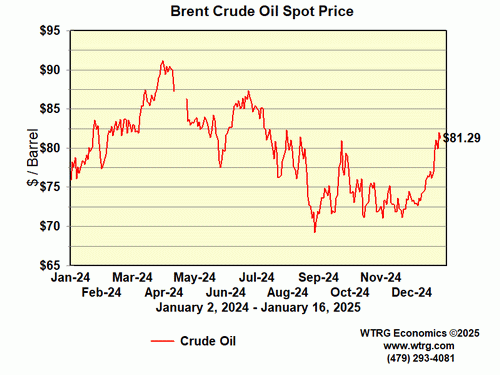
The crude prices reached a historical record USD 145 per barrel - nearly doubling compared to the previous year. A barrel holds 42 US gallons or about 159 litres of crude oil, making it USD 0.91 for 1 litre - almost double from USD 0.44 per dollar last year. This is the purchasing price of crude oil from the OPEC countries, and is not yet usable. The actual process is much more complicated, but at a very high level, it follows steps like transport it, refine it, process it, transport it again, store it, distribute it and make available at the local gas station. This adds additional costs to the original purchase price of Oil. Traditionally, the total production cost and profit on top with added government taxes becomes the sale price of the product to the end-consumer. However it may not work in that fashion all the time - countries like the US purchase crude at a different (lower) price from the market, and countries like China and Malaysia subsidise the product to bring the retail prices within consumable range for the common people. But then, beyond a point no government with the right economic policies would be able to insulate the global economic pressure of the price-rise. It is rather a misnomer that India subsidises gas and diesel. Consumers in India pay more for litre than the selling price of the Oil companies by the way of additional tax by the government.

[Above: Doubling of crude oil prices over past 366 days. Source: wtrg.com]

This is the good or "light" crude that is getting costlier. The world at large has the capacity to refine this rather crude product into usable Gasoline, Diesel, etc. Increasingly, many oil-wells have started drawing "heavy" crude for which the Oil companies worldwide have limited refining and processing ability. Oil processing giants like Reliance Petrochemicals is in the process of constructing world's largest oil refinery in India with a huge capacity of processing both "light" and "heavy" crude, but it would take a couple of years to be fully functional. The so called shortage of light crude might have put the crude prices under pressure, but by no equation it could make the prices go double over the previous year.

Furthermore, if someone argues that the Demand of Oil has grossly and suddenly outpaced the Supply, and that is forcing the Oil prices to rise, you are being taken for a ride. The demand is supposed to be well in sync with the production. It is the supply-chain that has gone for a toss, and by a certain account a suspicious mind might smell a mischief at work.

I suppose it takes only common sense to pose the question: the extra money that I am rather forced to cough up for every litre at the gas station, where does it go after all? It must be ending up into someone's pocket... There must be somebody who is accumulating a rather handsome capital in this fashion from around the world! And, there are a couple of possibilities:

In a very interesting documentary last month the BBC correspondent visited this once barren site where construction work is going on at a fanatic pace in the deserts of Saudi Arabia. The contractors, such as the Bin Laden Group, are trying to convert the uninhabitable sandy planes into King Abdullah Economic City which is one of the six of its kind - making it one of the largest desert reclamation project in the world.

[Right: The city in Saudi Arabia that consumes a major portion of a billion dollars of revenue every day that the Saudi Arabs acquire by selling oil to the world at a doubled price.]

It is reported that since they have doubled the crude oil prices, nearly USD 1 billion is pumped every day into the building of such cities by the Saudi people; the money that Saudi Arabia, the largest oil producer, acquires by selling crude oil.

[Related post: Oil Money Powering Windmills]
[Go here for the BBC story on the Saudi city and how they make/spend billions a day from rising Oil prices.]
[Go here for details about the controversial oil company Zapata Corporation founded by President George Bush, Sr.]
[Go here for a Bloomberg story on the "world's largest oil refinery".]
[Go here for an interesting article titled: Perhaps 60% of today's Crude Oil Price is Pure Speculation.]