Thursday, October 09, 2008

Google GeoEye: 'Big Brother' for the whole World?

JOHN DE MOL TOOK THE OLD PRISON CONCEPT of confinement, absorbed its mentality, attached psychological strings, created a manipulative environment, introduced conflicting personalities into it, televised it via mass media, commercialised it by asking people to pay by "voting", and produced through Endemol one of the most popular reality TV shows "Big Brother". While the producers claim that the show is not scripted, it surely remains a prompted show. The show now runs to various international formats in nearly 35 host countries, and is broadcast to more than 100. The central concept of the show is that one is always being watched all the time so far as one is within the premise of the designated Big Brother house.

You can run, but you can't hide.

Expand this premise to cover the whole world, and we get close to the Google GeoEye project. On September 6, 2008, the world's most-accurate commercial imaging satellite, the GeoEye-1 was blasted off into the space. The 4,300-pound satellite moves from the north pole to the south pole in a 423-mile-high orbit at 17,000 miles per hour (or 4.5 miles per second). The spacecraft can take photos at a resolution of up to 41 centimeters - close enough to zoom in on the home plate of a baseball diamond.

Interestingly for GeoEye, Google as a partner is the second biggest customer who would use the data (real-time images of the entire world) for purely commercial purpose. The largest customer of GeoEye data consumption remains the U.S. Government agency - NGA, that has been putting satellites into the space since 1970's to 'spy' on targets within the US and abroad (such as the Kremlin Square of Russia). While the NGA capabilities can even read from space the headline of the newspaper that one is holding on the ground, for Google however, the max permissible zoom limit of up to 50 cms would apply. This means that while you can easily see the red Mustang on Hawthorne Boulevard junction in LA, you perhaps won't be able to recognise the face of the blond seating on the passenger seat. In other words, the satellite can see, but can not show to you all those details because of the current legislative limitations.

With the next launch of a more powerful 'prying eye' - GeoEye-2 scheduled around 2012, which is capable of going to the resolution of up to 25 cms, Google surely hopes that the zooming restrictions would be relaxed. In other words, you might be able to spot people anywhere on Earth. And you might be able to do it all the time. And your target may not even be aware of your act or intent. If you start 'selling' your 'show' on, say, YouTube, you might have your own commercial version of "Big Brother" show. If the idea sounds familiar you may already have watched the 1998 superhit movie The Truman Show written by Andrew Niccol (see trailer below).
"We're commercializing a technology that was once only in the hands of the governments," Mark Brender, GeoEye's VP of communications said. "Just like the internet, just like GPS, just like telecom - all invented by the government. And now we are on the front end of the spear that is commercializing this technology."

[Images on the Right: 1) The Google logo rides on the main booster stage of the Delta-II GSLV rocket that delivered GeoEye in the orbit. source: wired.com. 2) The GeoEye setallite being launched on Sep 6, 2008 on board United Launch Alliance Delta-II rocket from Vandenberg Air Force Base, Calif., USA. source: geoeye.com. 3) View from the space of Kutztown University campus in Pennsylvania. On Oct 7 GeoEye-1 satellite, going into action, took this first ever hi-res image from the space. source: wired.com.]

There already are enough surveillance cameras on our roads, streets, stations, offices, malls and all public places. As the technology improvises and more GeoEye's start orbiting the Earth prying downwards, "Someone would always be watching you..."


[Above: Actor Jim Carrey plays Truman Burbank in the 1998 Hollywood film The Trueman Show. Depicting a Big Brother like Reality TV show on extremes before the Big Brother format was even possibly conceptualised, the film chronicles the life of a man who does not know that he is living in a constructed reality soap opera, televised 24x7 to billions of viewers across the globe.
Go here for this trailer on YouTube.]

You can run, but you can't hide.

  • See also:
  • Go here for more on John De Mol. And here for Endemol official website.
  • Go here for official GeoEye website. Looks like their business model expects you to pay for any image that you watch or use. Watch out!
  • Go here for the related story at wired.com.

Monday, October 06, 2008

The Financial Crisis: Who Let the Dogs Out

THE DEAL.COM HAS THIS USEFUL illustration explaining at a high-level chain of events leading to the current US financial crisis. The editor chose to describe it as chain-of-fools:


TheDeal.com illustration of chain-of-events leading to the US Financial crisis.
[Above: TheDeal.com illustration of chain-of-events leading to the US Financial crisis.]


The TIME MAGAZINE for this week features "Depression 2.0" through the following front-page across all editions worldwide. As the cover-story, economist Niall Ferguson narrates why it may not happen:


A Black & White photo of depression-era soup line in the USA.
[Above: A B&W photo of depression-era Free soup line in the U.S. featuring as the cover page of 13 Oct 2008 issue of the Time mag.]


Update: Embedded this interesting video on the (simplified) explanation on "Crisis of Credit".


The Crisis of Credit Visualized from Jonathan Jarvis.


  • See also:
  • Related article: Sub-prime Crisis for Dummies.
  • Go here for WIRED.COM version of "economic explanations [of the crisis] even we could understand" targeted towards the techie community.
  • Go here for the complete story "Chain-of-fools" at TheDeal.com
  • Go here for the Time mag current issue (Oct 13, 2008) and a very interesting narration for the common man by economist Niall Ferguson.

Tuesday, September 23, 2008

The Financial Crisis: Explanations

HERE IS AN HONEST STATEMENT OF ALL by Kedrosky and so I found an echo in his words below - especially the last line:
I pity [US] taxpayers wandering into the credit crisis story at this point. It is absurdly complex, and centers on a subject that most people neither care about nor understand. And the last time they looked in they were told this was about subprime and housing, which it no longer is -- at least not in large part.

Instead, it is a costly and complex saga involving the unwinding of global credit markets, overlaid with debt syndication, new derivatives, the collapse of the investment banking business, the changing nature of leverage, flawed risk models, structured finance, greed, the housing bacchanalia, savings, paranoia about prior credit crises, and the paradox of thrift. Don't forget, of course, populist political pandering in an election year.

Is it any wonder that most of even the most well-intentioned commentary on the current crisis sounds clueless, unhelpful and mildly dangerous?

Friday, September 19, 2008

The Machine is Us/ing Us -- by Michael Wesch

THIS APPARENTLY IS A GREAT START OF THE WEEKEND: watching this very interesting and equally famous clips by Michael Wesch, Prof. of Cultural Anthropology at Kansas State University.


[Above: this 5 minute clip is about ‘Web 2.0’, but it in fact narrates how IT works today, and has got integrated into social human lives. Apparently, this is also food for thought for the next business transformation endeavour...]

The 33 year old highly tech savvy Anthropologist also has this another great short clip on the same subject, this time on Information R/evolution - here on YouTube.

[Go here for Michael Wesch's personal pages on Kansas State Uni website.]
[Go here for the first clip about Web2.0 on YouTube.]

Monday, September 15, 2008

Lehman Bros Files for Bankruptcy Protection

THE 158 YEARS OLD INVESTMENT BANK FROM THE WALL ST. was finally 'allowed' to go bankrupt by the Federal Govt. By one observation time was against Lehman on two accounts - plenty as well as too short: on one hand, time was too short for them to find a suitable buyer and thus save filing for bankruptcy protection; on the other hand, their stakeholders were considered to have sufficient time to make appropriate arrangements and were thus considered fit to fend for themselves (and go bankrupt... Unlike in the case of Bear Stearns which was prevented from going bankrupt by being 'purchased' by JP Morgan and thus its stakeholders were rather spared).

It is not perhaps how large Lehman is and the impact it would generate; the real point to ponder is - is it the first is line? and, who would be next?

Also, is the market at large really ready for a new phase of consolidation? What is with the rumors of BofA and Merrill Lynch merger?

And while there is enough flux in motion, opinions are abound in all streams of media. In an interesting analysis of market reaction to the event through media, following graph shows how data on Wikipedia co-related with Lehman timeline:


[Go here for official Bankruptcy protection announcement.]
[Go here for Paul Kedrosky's 'tracking Lehman'.]

Friday, September 05, 2008

Sen. John McCain's George Bush Problem

THE EDITORIALS FROM THE LAST WEEK'S EDITION OF THE ECONOMIST declared that with respect to the Presidential election in the US, Republican Sen. McCain is almost tied with his Democratic contender Sen. Barack Obama on most opinion polls - something that was deemed inconceivable just a month ago. And add to that the enormous popularity - almost a jackpot for the Republicans, if you like - that the Republican Veep nominee, "the 'hot' Governor from the cold state", Gov. Sarah Palin garnered at the National Republic Convention early this week virtually pumped a fresh breath of life into the 2008 US Presidential race.

Siting the issue as McCain's George Bush problem and the need to distance himself from the incumbent President, the editorial goes on to conclude that "he sounds increasing like Bush III; [the American public] prefer McCain I".

Monday, September 01, 2008

Wordle: Measuring Yourself Up in Your Own Words

REGULAR BLOGGERS USE TAG-CLOUDS, and the sincere ones use them wisely. Whilst on one hand the tags help organise and categorise the posts and thoughts therein, they also help the author not to stray too much away (a cluttered tag-cloud is most likely an apparent symptom of this) from the topics and interests the blog is intended for and targeted towards in the first place.

On the other hand, the blog posts are made up in real language using real words that make up the composition by the author. And since the author has his/her own style with grammar and sentence construction, it forms a pattern or trend of words used to produce those thoughts marked under the given tags.

Wordle.net offers this beautiful applet utility that instantly creates a "word-cloud" by consuming your blog feed. Taking it one step further, one can then match this world cloud with the tag cloud of the blog, and make interesting inferences.

[Above: Word-cloud from the recent posts of this blog by Wordle.net]


I also found this word-cloud very useful for literary purposes as well: one could feed in the speeches of Sen. Barack Obama and Sen. John McCain on the topic of Economic policies, for example, and figure out how much do they agree or, apparently, disagree "figuratively". And also, where they agree (or match up word-by-word) could give the indication where the American Economy needs desperate help - or atleast they way any new leadership is most likely looking at it.

Paul Kedrosky already did such an experiment by comparing US Federal Reserves Chairman Ben Bernanke's speech this year with that of one year ago. The results are really intuitive. Here, take a look.

[Go here to make your own Wordle word-cloud.]

Saturday, August 16, 2008

The Fastest Men at the Olympics

IT TAKES YEARS TO SHED SECONDS OFF RECORD TIMINGS, and that has been the order of all major sports event, especially the Olympics Games. "Faster, Higher, Stronger" (Latin: Citius, Altius, Fortius) is the motto of the Olympics events, and whilst it absolutely lives up to that expectations, the bar thus raised however poses faster, higher and stronger challenges to the human capacities; every single time. (Mr. Ketan J. Patel, founder and head of the Strategic Group at Goldman Sachs, in this very interesting book "The Master Strategist" published earlier this year provides a very interesting analysis and analogy on the topic of such a human endeavour where Patel observes that we indeed live in the age of extremes.)

Usain "Lightening" Bolt of Jamaica is clearly my hero of the 2008 Summer Olympics games at Beijing, as with many others. Here is an athlete in what is called a championship form - with spirit exuberant that "no one can beat me today" - and to borrow the simile from Abraham Maslow - "Peak experience" in motion...

Three times, in three days, shattering three world records - Human spirit at its foremost, for, unlike a machine-like race for the next milestone, one did pause to marvel the moment and live in its spirit.


[Usain "Lightening" Bolt of Jamaica betters his own word record by 0.03 seconds at Men's 100m sprint race - the event that virtually decides the "fastest" man on earth. Bolt not only took a convincing lead among the pack, but maintained it all along and started celebrations even before the finish line was ten meters away; all this within sub-10 seconds time-frame. Above: Take a look at this footage from the stadium.]

And then there is Michael Phelps of the USA, the most decorated athlete of all times at the Olympics, winning eight Gold medals in eight aquatics events - getting a Gold in all events in which he participated at 2008 Summer Olympics games, and setting a record for doing so also. Phelps is special in more ways than one.

[Steve Parry finished on the podium beside Phelps at Athens 2004. While Phelps captured Gold and set a new WR, Parry at the same time set a new Commonwealth record for the same event in aquatics. Above: Parry analyses how Phelps is 'special' in the pool.]


[Go here for the Amazon book reviews of "The Master Strategists" by Ketan Patel.]
[Go here to watch Bolt during his M 100m final on the official YouTube broadcasting channel of Beijing Olympics. These clips have very little chance of being removed.]
[Go here for the detailed analysis by Steve Parry
for BBC.]

Wednesday, August 13, 2008

Five Lessons from Sub-prime Crisis

PHILIP J. PURCELL, FORMER CEO AND CHAIRMAN OF MORGAN STANLEY, proposed the big five lessons for bankers coming out of the current Sub-prime crisis of the US.

For the record, during Mr. Purcell's tenure as CEO at Morgan Stanley for eight years the firm attained following milestones at the close of 2004:
#1 in global equity trading
#1 in global equity underwriting in 2004 for first time since 1982
#1 global IPO market share in 2004
#2 in global debt underwriting in 2004, with steady gains since late '90s
#2 in completed global M&A in 2004
Mr. Purcell resigned from Morgan Stanley in 2005, and has since founded a private equity firm called Continental Investors LLC.

Following are the 'lessons' that he recently discussed through an article in FT:

i) profits matter more than revenues (sales)

ii) compensation should be based on profits, margins and return on equity over time, not current year revenues

iii) leverage works not just on the upside but on the downside as well

iv) diversified and recurring revenue streams not based on trading or principal investing have immense value in a down cycle

v) risk management should become a board-level responsibility, with appropriate committees meeting regularly with management

[Related post: Sub-prime Crisis for Dummies]
[Go here for the Financial Times article where Mr. Purcell explains each in more details.]

Monday, August 11, 2008

Golden Gift for India at 2008 Summer Olympics

FOR THE FIRST TIME EVER IN THE HISTORY OF MODERN INDIA as well as modern Olympics, the Indian National Anthem was sounded for the podium Gold position in an individual event. A moment of pride for any Indian national/origin anywhere. The German media person standing nearby the Indian supporters' stand at Beijing Shooting Range Hall was as perplexed as the Indians themselves. The German was stumped for his lack of knowledge of India never making it to the Gold in the history of the nation or the games; the Indians were stumped and elated of course because their shooter finally made it!

It is perhaps the best gift that India ever received from a peaceful sports event thus far. Abhinav Bindra, the 26 year old businessman from Chandigarh, an MBA from USA and CEO of his own video-game company, at his third Olympics appearance aimed a near perfect bullseye in 10m Air Rifle event and brought India home with its first Gold in an individual event at the Olympics - classic or modern. And when asked by a TV channel during an interview, the medal barer didn't mince his words while saying, "I wonder why it took [India] so long..."

[Left: Abhinav Bindra’s Swiss coach Gabriele Buhlmann congratulates him at the Beijing University Gymnasium. Source: in.news.yahoo.com]

It is a gift to the nation because this self-financed, self-trained, self-sponsored effort by an individual from an affluent background comes from trainings in South Africa and Germany with the help from a Swiss coach. "Gaby" Bühlmann, the personal coach of Bindra, participated in 10 shooting events at five previous Olympics for Switzerland; the last one being at Athens 2004. Bindra has his personal Olympics-standard shooting range facilities built by his father in their own backyard, and he has been training far away from the official, government provided, and Indian Olympics Association sponsored facility at Tughlakabad outside New Delhi that has not received any upgrade to the equipments since 1980's.

And while most predictably as Bindra becomes the new darling of the news desks across India, interestingly two Chinese national daily also featured him on full-size front page coverage - albeit, the headline read, a rather tongue in cheek, "At Last!"

This may be Indian sports coming of an age. The public-private partnership is evident yet again, with reports of the steel tycoon and the richest man in the UK, Laxmi Niwas Mittal funding at least 14 Olympian hopes for India, including Bindra. Mr. Mittal runs his Mittal Champions Trust from London, and reportedly employed a physical trainer, a psychologist, and supplied ammunition for practice for Bindra when India ran out of bullets for the Olympics team.

There were no bidders for the 2008 Olympics telecast for India, and the rights for the entire event were finally picked up, with a bare minimum chance of breaking even, by the I&B ministry for national career DD Sports for USD 3mn (which was the price for just a couple of icon player at the Indian Premier League Cricket auction. The broadcast rights for India for the IPL event as a whole were sold at slightly over USD 1bn).

Formula One was a no-show in India only five years ago until Karthikeyan came on the scene as the first Indian driver for the Grand Prix race, and F1 has picked up since then in the country - with India sporting its first ever full fledge racing team - Force India - starting this year. Moreover, an F1 race circuit at Noida (near New Delhi) is under construction for inclusion in the F1 calendar by 2010 season.

Could Bindra's feat do something similar for the Olympics in India?
Perhaps.
How about Indians' call for Cricket's inclusion in the Olympics?
A Twenty20 Olympics... Why not?

[Related post: 08.08.08 - World Watches as China Arrives with the Olympics]
[Go here for an eyewitness account also mentioning Gagan Narang, Bindra's team mate at the same event.]

[Go here for the official athlete profile of Abhinav Bindra at the Olympics.]
[Go here for the China Daily front-page coverage on Bindra's gold.]


Edit: new links have been added for "Gaby" Bühlmann , Laxmi Mittal's funding for Bindra, and others.

Saturday, August 09, 2008

08.08.08 - World Watches as China Arrives with the Olympics

ONE OF THE MOST MESMERIZING EXPERIENCES OF RECENT TIMES, the live performance of the opening ceremony of the 29th modern Olympics at Beijing surpassed all expectations. Even the foreign correspondence who have been in Beijing since a few months, measuring the air-quality, spying, and commenting on the build-up, and covering the unveiling of the Olympics, in spite of having stolen away a video footage from the rehearsals a week ago, were neither aware of nor prepared for the enthralling experience of the pinnacle event - lighting of the Olympics torch...


[Above: Li Ning "walks" on the walls, with the backdrop of video panels on the edge of the roof of Bird's Nest, on his way to light the 29th Modern Olympics torch at Beijing on August 8th, 2008 at 08.08pm CST.
Here is this footage on YouTube.]


Unquestionably, China has arrived. Hello World!

As they say, well began is half done... And going by the analyst reposts, I suppose the icing on the cake for them would be the closing ceremony with China bagging most Gold medals!

[Related post: The Dalai Lama meets with the Mahatma]
[Go here for the official games schedule, and here for the medals standings.]

[Go here for a guide on How to watch the Olympics online.]
[Go here for the BBC coverage of the opening ceremony.]
[Go here for the list of "the ten Chinese people you should know about" - including Li Ning who is the biggest sports brand in China.]

Saturday, July 12, 2008

Sub-prime Crisis for Dummies

THE CLOUD OF SUB-PRIME CRISIS JUST GOT HEAVIER, DARKER AND LARGER. The New York Times reported that the Federal Government may assume direct control of the two of the biggest mortgage-finance companies in the US to bail them out: Fannie Mae and Freddie Mac. These two have nearly 45% of mortgage market share between them, and could potentially tank about USD 5 trillion if they go down. On the other hand, the bail-out of this magnitude might blow away credibility of USD, and imperilling the Fed budget.

[Left: Nose-dive - from USD 70 per share last year to USD 9 per share. source: Reuters.com]

There is a sense of politics being involved since the NYT report of "nationalization" came out earlier this week. This further took a large chip off the share prices of both and the decline continued for the whole week in spite of confident building reports from the promoters. Fannie Mae's stock, for one, has lost most of its value, swooning from peaks around $70 in August 2007 to their current $9 per share in July 2008 - a steep nose-dive of net-worth.

This crisis is not "for dummies" for sure. The nature of economy is global with respect to credit/liquidity and oil - the two primary trade elements. Any movement within a given sector or region of these two is propagated all around. It is only a matter of time before the crisis-call reaches the so called developing economies. The globalization is a giant beast of a dinosaur, as it were, so huge that it could have taken about half an hour for a shoe-bite pinch to reach its brain and give out a scream.

Economists have piece by piece deconstructed the "positive" outlook of stability and insulation of the economy that was recently given by the Governor of the Reserve Bank of India. One may argue that the early warning signs are already up: inflation rates have doubled, and the growth rates have halved for H1 of the current fiscal for India.

The numbers that are coming out are overwhelming, and before it really gets too complicated I thought it worthwhile to educate myself, yet again (see links below): to begin with, how the sub-prime crisis came about in the first place.

[Above: For dummies, here is an illustrated slide-show titled "Sub-prime premier": http://www.businesspundit.com.]

[Sub-prime crisis for dummies: Go here for an illustrated slide-show titled "Sub-prime premier".]
[Go here for a Reuters report on "Fannie, Freddie bailout would imperil budget, dollar".]
[Go here the initial NYT report of "takeover" that came out this week.]
edit: [Can India prevent a sub-prime crisis?. Go here for a review in ET of Robert Shiller's recent book: The Sub-Prime Solution (Princeton)]

Tuesday, July 08, 2008

HBR: "The Right Way To Be Fired"

NO EMPLOYMENT CONTRACT HAS A PERMANENCY CLAUSE. The category "permanent employee" is only to differentiate one from temps - both remain time-bound nonetheless. There may be a clause in the employment contract talking about retirement age of an employee, and rather misleadingly, that might go on to give an impression to the newly joined that her job is secure and permanent until the age of say 60 years. However, in reality that section of the employment terms is just another clause suggesting when would you be required to leave your present job. As the "globalization" story propagates to more and more regions and industries, it is getting increasingly important, especially to the optimistic lot like myself too young for that retirement age yet, that the realities of the impermanent nature of jobs and employment be realised, the sooner the better, such that one can make a more informed and rewarding career planning.

They also call it acting "professional".

In essence, an organization employs personnel because and until it requires them. Unlike perhaps government jobs, no organization is obliged to continue an employment on a sort of permanent basis. It has never happened in the history of employment. The primary function of a Human Resources department is thus to create a comfort-zone called 'sense of permanency' where there may not be any for real. Job cuts, Pink slip, Resignation, Hire/Fire, and Layoffs are rather harsh words in the politically correct arena of corporates and employment, but they are as relevant and real as the pay cheque; and that is why the top career planners and advisory firms counsel with their clients to have what is called a "severance contract" embedded within the job offer-letter itself.

At the risk of having an anti-climax or feeling counter-intuitive for having to talk about separation formalities while discussing joining details, Maryanne Peabody and Dr. Laurence J. Stybel, after 22 years of research and working with more than 500 top executives, argue that "it's your best hedge against a bitter exit" and would come to one's rescue in so many ways when things get "uncomfortable". The case in point: prenuptial agreement that protects both sides, and the face-saving usefulness it has shown over the years.

Having come too close for comfort myself to such a scenario I was nodding almost all the way through this very interesting and relevant paper by Peobody and Stybel titled "The Right Way To Be Fired" and published by Harvard Business Review under Managing Your Career series (see links below). Following is an excerpt from the executive summery section (emphasis added):
Nearly all of us will lose our jobs sometime, but is there a right way to be terminated? What differentiates fired employees who make the best of their situation from those who do not? One answer is mind-set. Many 'workers' unconsciously hold a "tenure mind-set", believing in the promise of employment security. By contrast, other workers hold an "assignment mentality", seeking each job as one in a series if impermanent, career building stepping-stones. Most corporate board members and CEO's have this later mentality and consider their executives to be terminal assignments...

When the employees who hold the tenure mind-set are suddenly laid off, they can fall into three common traps: "lost identity" trap - executives who have over-identified with their jobs and feel indispensable fall into this trap and react to termination with anger and bitterness; "lost family" trap - employees who posses tight-knit, emotional bonds with co-workers feel betrayed and rejected when fired; "lost ego" trap - some introverted executives fall into this trap and they quietly retreat without negotiating termination packages.

To prepare for the eventuality of termination it is suggested that executives adopt assignment mind-set all the times. They should keep their social network alive, include a termination clause in employment contracts, and consider hiring an agent [...] By assuming control over the way they are fired, people can gain control over their careers...
As in almost all walks of life the key has been identified as Mind Gap. The paper is very well illustrated with real-life examples and handles the delicate issues with required gentleness as well as practical wisdom. Whilst the situation of job loss is almost a daily news in the high-cost and profit-centric regions, the so called low-cost locations are also catching up, for every organization would want to replicate itself albeit at a smaller scale when it creates presence in the low-cost region, and in doing so also clones its HR policies.

Going through the Pink-slip tales and their economic ramifications one can not help but have the sense of living dangerously in the contemporary corporate environment. Along with the suggested mitigation strategies in the paper, I noticed "impermenance" being mentioned at least once on each and every page. And I could not help but carry the reference further to the premise called Three Marks of Existence in Buddhism where anicca (impermenance) is one of them.

Finally, as they say:
Jobs belong to the organizations, but careers belong to the individuals.
Update: HBR ran a cover story - The layoff - in their March' 09 issue. Go here for the online copy.
  • See also:
  • Related article: Five lessons from Sub-prime crisis
  • Go here for purchasing this HBR article "The Right Way To Be Fired" from Harvard online store
  • Go here for the official website of Stybel Peabody & Associates
  • Go here for a relevant story by Y! news: "Executives afraid to take holidays in case 'they lose jobs'"

Monday, July 07, 2008

"mind × the + gap" overhauled (July '08)

AFTER SPENDING NEARLY 6 MONTHS under the old 'skin', I thought it was almost time to give "Mind the Gap" an overhaul in look-and-feel. And trust me, it turned out to be a worthwhile and satisfying weekend indeed: Loading up Photoshop for 'grafix' on one hand and coding/debugging xHTML, css, js, and the whole of tech jargon on the other. Almost reliving the time ten years ago, the dot-com boom, and designing, developing and coding of websites with a passion of a rather naive young rookie, just "out-of-the-box" programmer!

It was annoying to some degree that Google has most of its products and services under Beta - and they never seem to move out of wrappers. You hardly see any changes or progress. In specifics, I was not happy at all with the tiny collection of templates that are available by default with the Blogger system (have you ever visited any of those beautiful WordPress or LiveJournal pages of your friends (or competition) that left you with the impression that they must be maintaining their own full-fledged websites?)

So, I did try the competition, and in the process I had the revelation *why* I loved Blogger.com over any other blog publishing software - Blogger gives you much more control and flexibility over your stuff (WordPress, for example, doesn't allow you to add even a simple hit-counter of your choice to your blog there! Sham!).

And, perhaps more importantly, add to that the default 'parenting' by Google to list you among its search indices. After all, everybody likes to be *counted*, be it vanity hit-counts...

Having said that, at the end it is all about usability of the system, usefulness of the info, and the presentation and end-user (you!) experience. Well, I hope this new avtar is as enjoyable as the old one. (Those couple of known bugs that there are, that I would be fixing really soon.) From software/system usability perspective, some of the elements that I liked in the new design in particular are:
  • the neat menu system in the left nav bar (a typical WP feature called 'pages')
  • more spread-out font-system that reduces the clutter
  • a two-column layout that I prefer - with navigations on the left, better space-utilization - it doesn't misleadingly increase the 'length' of my posts - something that I am particularly sensitive about
  • manages to do so in less than 800px width
  • gives me enough space around images and video for captions and notes
  • follows the same brown-background colour-theme that I chose with the previous template...

The base code of this new skin is from a WP theme, which I downloaded from Jackbook.com (Thank you, Jacky.). The theme was originally coded by Web-Kreation for WP. Following are my recommendations to spice up your life (read: blog) too ;-):

All the best!

Friday, July 04, 2008

4th of July, The US National Anthem, and Outsourcing

THE U. S. CELEBRATES ITS INDEPENDENCE DAY TODAY, July 4th. The custom involves the state sponsored fireworks accompanied by songs such as the National Anthem - The Star-Spangled Banner.

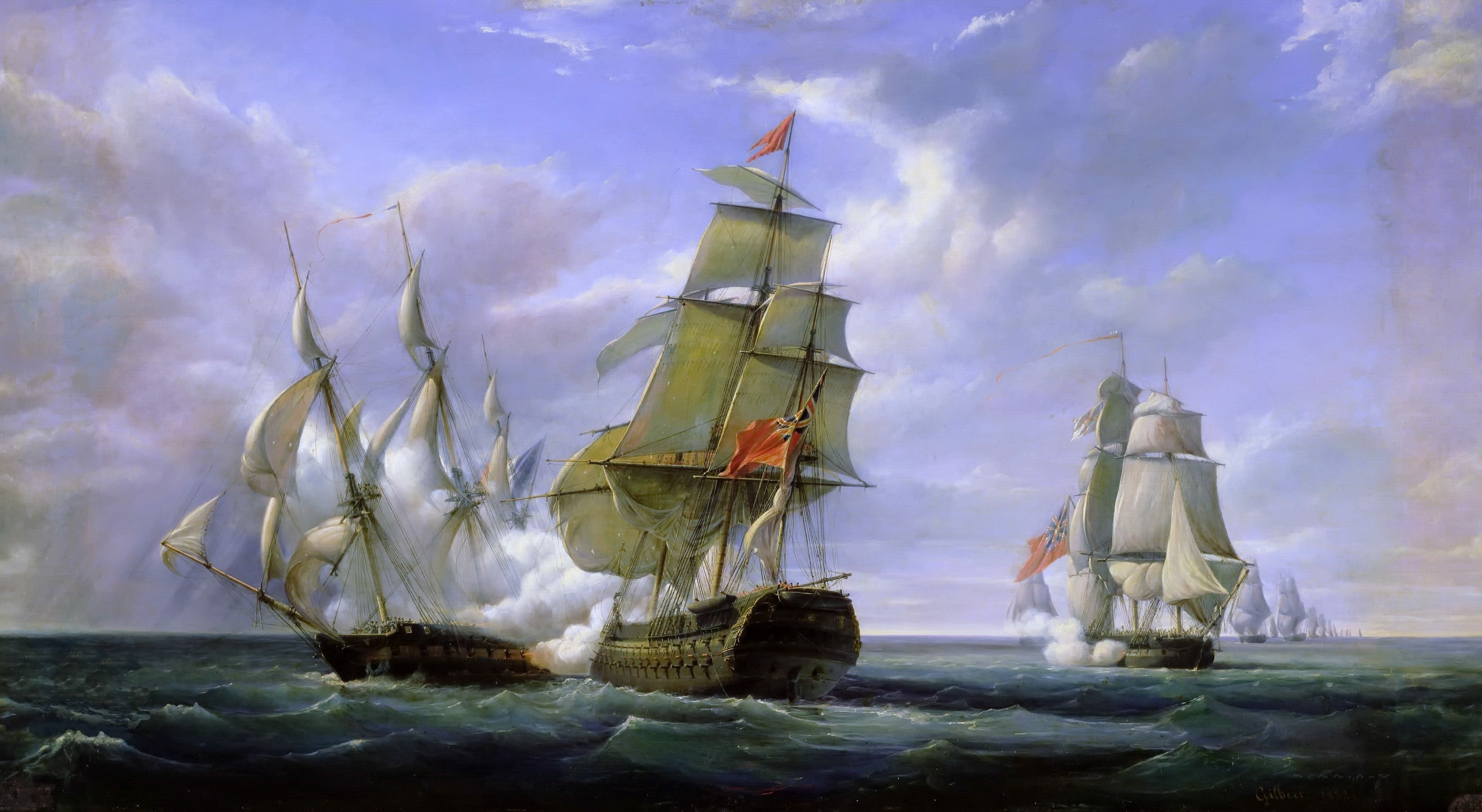
[Right: A Ganges-class ship, to which HMS Minden belonged, at war with French Navy in 1806.]

The national anthem, which originally was a poem titled "Defence of Fort McHenry" was written by one Francis Scott Key. Mr. Key, a lawyer by profession, was visiting certain British officials at Royal Navy ships at that time.

The point in case here is that the ship HMS Minden, a Ganges-class ship, aboard which this national anthem is first conceived and written was Made in India. The ship was built by one Mr. Jamshedji Bomanji Wadia, a merchant of Bombay. And by this account of trivia, the Outsourcing relationship, as it were, between the US and India is as old as 1801 when this ship was first built at Bombay dockyard, one of the best ship-building dockyards of the world at the time.

Happy 4th of July!

And, to quote Jefferson's famous preamble for the Declaration of Independence on this day in 1776:
We hold these truths to be self-evident, that all men are created equal, that they are endowed by their Creator with certain unalienable Rights, that among these are Life, Liberty and the pursuit of Happiness.

On a lighter note, below is Happiness with a 'y':

[Above: A scene from a spirited portrayal of "American Dream" in this 2006 Hollywood film "The Pursuit of Happyness" based on the true life-story of Self-made American millionaire businessman and stockbroker Chris Gardner. Will Smith plays the lead role. Smith has also played the Hero in the sci-fi "The Independence Day" of 1996.]

Thursday, July 03, 2008

Who Pockets the Extra Money I Pay For Gas?

THERE IS NO PLACE CALLED "KING ABDULLAH ECONOMIC CITY" in the world as of now. But perhaps it wouldn't be long before we see a spot on Google Earth with such a name having 3 million in population, partly thanks to the sky-rocketing Oil prices.

Interesting Headlines: "The Crude At Rude Prices"
and
"Oil Crises called Oil Prices"
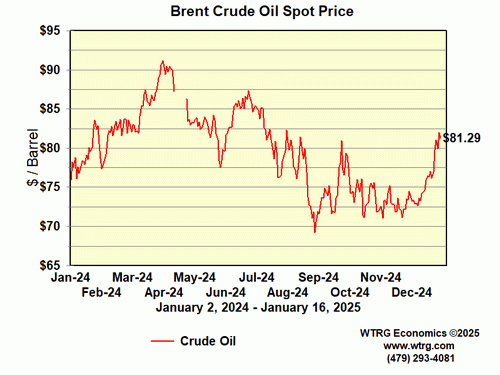
The crude prices reached a historical record USD 145 per barrel - nearly doubling compared to the previous year. A barrel holds 42 US gallons or about 159 litres of crude oil, making it USD 0.91 for 1 litre - almost double from USD 0.44 per dollar last year. This is the purchasing price of crude oil from the OPEC countries, and is not yet usable. The actual process is much more complicated, but at a very high level, it follows steps like transport it, refine it, process it, transport it again, store it, distribute it and make available at the local gas station. This adds additional costs to the original purchase price of Oil. Traditionally, the total production cost and profit on top with added government taxes becomes the sale price of the product to the end-consumer. However it may not work in that fashion all the time - countries like the US purchase crude at a different (lower) price from the market, and countries like China and Malaysia subsidise the product to bring the retail prices within consumable range for the common people. But then, beyond a point no government with the right economic policies would be able to insulate the global economic pressure of the price-rise. It is rather a misnomer that India subsidises gas and diesel. Consumers in India pay more for litre than the selling price of the Oil companies by the way of additional tax by the government.

[Above: Doubling of crude oil prices over past 366 days. Source: wtrg.com]

This is the good or "light" crude that is getting costlier. The world at large has the capacity to refine this rather crude product into usable Gasoline, Diesel, etc. Increasingly, many oil-wells have started drawing "heavy" crude for which the Oil companies worldwide have limited refining and processing ability. Oil processing giants like Reliance Petrochemicals is in the process of constructing world's largest oil refinery in India with a huge capacity of processing both "light" and "heavy" crude, but it would take a couple of years to be fully functional. The so called shortage of light crude might have put the crude prices under pressure, but by no equation it could make the prices go double over the previous year.

Furthermore, if someone argues that the Demand of Oil has grossly and suddenly outpaced the Supply, and that is forcing the Oil prices to rise, you are being taken for a ride. The demand is supposed to be well in sync with the production. It is the supply-chain that has gone for a toss, and by a certain account a suspicious mind might smell a mischief at work.

I suppose it takes only common sense to pose the question: the extra money that I am rather forced to cough up for every litre at the gas station, where does it go after all? It must be ending up into someone's pocket... There must be somebody who is accumulating a rather handsome capital in this fashion from around the world! And, there are a couple of possibilities:

In a very interesting documentary last month the BBC correspondent visited this once barren site where construction work is going on at a fanatic pace in the deserts of Saudi Arabia. The contractors, such as the Bin Laden Group, are trying to convert the uninhabitable sandy planes into King Abdullah Economic City which is one of the six of its kind - making it one of the largest desert reclamation project in the world.

[Right: The city in Saudi Arabia that consumes a major portion of a billion dollars of revenue every day that the Saudi Arabs acquire by selling oil to the world at a doubled price.]

It is reported that since they have doubled the crude oil prices, nearly USD 1 billion is pumped every day into the building of such cities by the Saudi people; the money that Saudi Arabia, the largest oil producer, acquires by selling crude oil.

[Related post: Oil Money Powering Windmills]
[Go here for the BBC story on the Saudi city and how they make/spend billions a day from rising Oil prices.]
[Go here for details about the controversial oil company Zapata Corporation founded by President George Bush, Sr.]
[Go here for a Bloomberg story on the "world's largest oil refinery".]
[Go here for an interesting article titled: Perhaps 60% of today's Crude Oil Price is Pure Speculation.]

Friday, June 27, 2008

So Long, King Gates

FINALLY, THE IT TZAR TAKES THE BACK SEAT. And as Mr. Bill Gates completes his last full working day by the EOD today - June 27, 2008 - at his Richmond, WA office in the US, an era of Biggest, Richest, and Fastest draws towards a change. Call him Innovator, Software Evangelist, Chief Software Architect, or by any other name, above all, Mr. Gates is a successful businessman, Zero-to-billions kind. And that is how I would want to reckon him, for Mr. Gates is not perhaps a mesmerising orator, neither a charismatic leader, nor a magnanimous personality. Even if he is all of these, they rather remain secondary, for the bottomline is, Mr. Gates knows business, does business and means business. Period.

Arguably the world's most famous dropout - and thus perhaps the tallest example that education and money may not have a direct corelation - wrote the first BASIC compiler 17 years ago, and left the legacy as the world's richest man with such words: "There is nobody getting rich writing software that I know of...".

[Left: Bill Gates, CEO, about 27, in his Microsoft office in 1982. Source: time.com. Do you also feel that the DOS screen in front of him reads something very similar to "Bad Command or File name?"]

Mr. Gates indeed has been the biggest catalyst for last two decades for the IT industry and for the global economy at large - Windows OS still runs more than 90% of personal computers in the world, and Microsoft Office artefacts are the de-facto standard for offline information and data transaction. This has made Mr. Gates the richest man on earth; reaching there in the fastest possible manner - at the speed of thought, if you like...

On my part, it was a wonderful experience to listen to him from a mere few feet away in Sep 2002 while he was delivering a lecture and providing with his vision (such as, "XML is the future...") at the time of the launch of Windows XP. It being my first encounter with a global leader at close proximity left me with a lasting impression.

Competition has not been kind to Mr. Gates, and visa-versa is probably equally true. Sort of a reminder of the old saying that Friends come and go, enemies accumulate...

The success of Microsoft Corporation undoubtedly has contributions from many more than Mr. Gates and his "Big Picture" memos alone, but in the world-wide (Globalization?) game of business where media and economy are increasingly tying up, and where winner takes it all, the credit nonetheless has almost always been attributed to Mr. Gates as the poster-boy face of Microsoft. At the same token, the discredit of bad designs, security flaws and sloppy software performance is also to the discredit of Mr. Gates.

[Right: Culturing Innovation; Sponsoring ImagineCup. Bill Gates in Korea for the event in 2007.]

It would be an interesting experience for Bill Gates to become a user from the owner of Microsoft products. His displeasure towards many thing Microsoft, especially the usability and user-friendliness, has been known. (Here is the full text of a rather interesting and lambasting email supposedly from Gates himself.)

BillG, as they call him, has never faced any job interviews, and in that respect he would perhaps always remain inexperienced! Unless of course any of the prospective next career moves (as in the following video) click for him :-)

Mr. Gates opened his keynote of TechEd 2008 last month with the following video. This is where Mr. Gates tries various career changes now that he is to move out of Microsoft. It has been making rounds on YouTube since Jan this year, and it's honest, well choreographed, very humorous and well entertaining. Not worth missing at all!


[Above: Bill Gates, Last Day at Microsoft. Simply Brilliant! Go here for the YouTube link.]


Bill Gates is going to be just fine whatever new avtar he may adorn next. But the industry observers seem to be divided over what would happen to Microsoft in absence of its poster-boy. I recall a media interview a few years ago where the reporter indirectly inquired about the "Google threat".
Mr. Gates replied and I quote, "Every couple of years a new company comes up and people say that it would put us [Microsoft] out of business. And every time I say, 'No, not this time'..."

If monopoly and monarchy have anything in common, we should shortly hear, "The King is dead... Long live the King!"

Let's see who would stand up and say "No, not this time..." for Microsoft next.

[Go here at time.com for the Photo-essays on Bill Gates' early days.]

Friday, June 13, 2008

"The Beautiful Mind" Turns 80

"The special commodity or medium that we call money has a long and interesting history. And since we are so dependent on our use of it and so much controlled and motivated by the wish to have more of it or not to lose what we have we may become irrational in thinking about it and fail to be able to reason about it as if about a technology, such as radio, to be used more or less efficiently..." -- John F. Nash, lecture at CII in Mumbai, Feb 2007
IF THE WORLD IS CONSIDERED A "CLOSED SYSTEM", deeming it a Zero-sum game, Nash Equilibrium could certainly offer a different meaning to the notion of money, and thus, to the word richness or net-worth and the world economy.
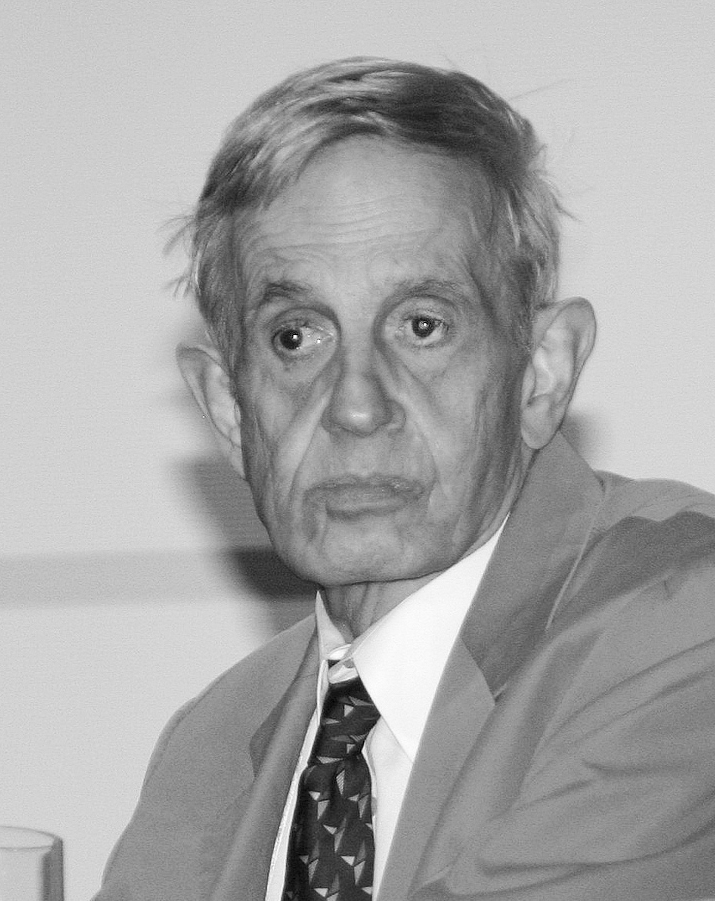
[Today, June 13, John F. Nash, Jr. turns 80. A humble tribute to the 1994 Nobel Laureate legend.]

Arguably, the Nash equilibrium is the single game theoretic solution concept that is most frequently applied in economics. In terms of strategy and planning, the equilibrium could be simplified as:
"For any finite, non-cooperative game of two players or more, no player can improve his/her pay-off by unilaterally changing the strategy..."

[Above: Actor Russell Crowe in his Oscar winning portrayal of John Nash in the 2001 Hollywood film A Beautiful Mind.]
  • See also:
  • Go here for Nash's personal home page at Princeton.
  • Go here at Investopedia for the investment perspective of the theory.
  • Photo courtesy: Prof. Lynne Butler.

Wednesday, June 11, 2008

ImagineCup 2008 - Runnup

"Achieve What You Can Imagine." --imaginecup.co.uk

invention, innovation, inspiration, imagination...

If any of the i's tantalise you, entertain yourself with this cute little 1.5 minute teaser video, which in fact is a runnup to the ImagineCup 2008 due this month.


"Great innovators don't imagine things in the future;
They imagine them in the present,
and change the future..."

Go here for a list of Software Project designs that made it to the semi-finals of the innovation competition this year.

[The video above is one among many created by the students of Ravensbourne College of Design and Communication. Go here for the video on YouTube, and here for other possibilities from Microsoft.]

Edit: The '08 finals will be held in Paris between July 3 and 8, 2008.

Sunday, June 08, 2008

Clinton bows out of the race to the 'White'house

Yahoo: Clinton suspends campaign, endorses Obama.

And now, it is 'young' Barack Obama pitted against 'experienced' Mr. McCain.

Let's suppose that Senator Obama continues the momentum, wins over the Clinton vote-split, manages to prove that young is the new 'old', defeats the myth by showing that change could also be other than what is loose in your trouser pocket, and finally makes it to the 'White'house, should he rename it?

[Above: Girls from Obama village in Japan dancing for Barack Obama's campaign.]

Talking about names, I am almost certain that it is purely coincidental that Baraq Obama sounds so similar with the two other major disasters for the Bush Administration: Iraq Osama

Edit: Oh, by the way, Obama's middle name, through his Kenyan father, is Hussein - as in Saddam Hussein...