Tuesday, July 08, 2008

HBR: "The Right Way To Be Fired"

NO EMPLOYMENT CONTRACT HAS A PERMANENCY CLAUSE. The category "permanent employee" is only to differentiate one from temps - both remain time-bound nonetheless. There may be a clause in the employment contract talking about retirement age of an employee, and rather misleadingly, that might go on to give an impression to the newly joined that her job is secure and permanent until the age of say 60 years. However, in reality that section of the employment terms is just another clause suggesting when would you be required to leave your present job. As the "globalization" story propagates to more and more regions and industries, it is getting increasingly important, especially to the optimistic lot like myself too young for that retirement age yet, that the realities of the impermanent nature of jobs and employment be realised, the sooner the better, such that one can make a more informed and rewarding career planning.

They also call it acting "professional".

In essence, an organization employs personnel because and until it requires them. Unlike perhaps government jobs, no organization is obliged to continue an employment on a sort of permanent basis. It has never happened in the history of employment. The primary function of a Human Resources department is thus to create a comfort-zone called 'sense of permanency' where there may not be any for real. Job cuts, Pink slip, Resignation, Hire/Fire, and Layoffs are rather harsh words in the politically correct arena of corporates and employment, but they are as relevant and real as the pay cheque; and that is why the top career planners and advisory firms counsel with their clients to have what is called a "severance contract" embedded within the job offer-letter itself.

At the risk of having an anti-climax or feeling counter-intuitive for having to talk about separation formalities while discussing joining details, Maryanne Peabody and Dr. Laurence J. Stybel, after 22 years of research and working with more than 500 top executives, argue that "it's your best hedge against a bitter exit" and would come to one's rescue in so many ways when things get "uncomfortable". The case in point: prenuptial agreement that protects both sides, and the face-saving usefulness it has shown over the years.

Having come too close for comfort myself to such a scenario I was nodding almost all the way through this very interesting and relevant paper by Peobody and Stybel titled "The Right Way To Be Fired" and published by Harvard Business Review under Managing Your Career series (see links below). Following is an excerpt from the executive summery section (emphasis added):
Nearly all of us will lose our jobs sometime, but is there a right way to be terminated? What differentiates fired employees who make the best of their situation from those who do not? One answer is mind-set. Many 'workers' unconsciously hold a "tenure mind-set", believing in the promise of employment security. By contrast, other workers hold an "assignment mentality", seeking each job as one in a series if impermanent, career building stepping-stones. Most corporate board members and CEO's have this later mentality and consider their executives to be terminal assignments...

When the employees who hold the tenure mind-set are suddenly laid off, they can fall into three common traps: "lost identity" trap - executives who have over-identified with their jobs and feel indispensable fall into this trap and react to termination with anger and bitterness; "lost family" trap - employees who posses tight-knit, emotional bonds with co-workers feel betrayed and rejected when fired; "lost ego" trap - some introverted executives fall into this trap and they quietly retreat without negotiating termination packages.

To prepare for the eventuality of termination it is suggested that executives adopt assignment mind-set all the times. They should keep their social network alive, include a termination clause in employment contracts, and consider hiring an agent [...] By assuming control over the way they are fired, people can gain control over their careers...
As in almost all walks of life the key has been identified as Mind Gap. The paper is very well illustrated with real-life examples and handles the delicate issues with required gentleness as well as practical wisdom. Whilst the situation of job loss is almost a daily news in the high-cost and profit-centric regions, the so called low-cost locations are also catching up, for every organization would want to replicate itself albeit at a smaller scale when it creates presence in the low-cost region, and in doing so also clones its HR policies.

Going through the Pink-slip tales and their economic ramifications one can not help but have the sense of living dangerously in the contemporary corporate environment. Along with the suggested mitigation strategies in the paper, I noticed "impermenance" being mentioned at least once on each and every page. And I could not help but carry the reference further to the premise called Three Marks of Existence in Buddhism where anicca (impermenance) is one of them.

Finally, as they say:
Jobs belong to the organizations, but careers belong to the individuals.
Update: HBR ran a cover story - The layoff - in their March' 09 issue. Go here for the online copy.
  • See also:
  • Related article: Five lessons from Sub-prime crisis
  • Go here for purchasing this HBR article "The Right Way To Be Fired" from Harvard online store
  • Go here for the official website of Stybel Peabody & Associates
  • Go here for a relevant story by Y! news: "Executives afraid to take holidays in case 'they lose jobs'"

Monday, July 07, 2008

"mind × the + gap" overhauled (July '08)

AFTER SPENDING NEARLY 6 MONTHS under the old 'skin', I thought it was almost time to give "Mind the Gap" an overhaul in look-and-feel. And trust me, it turned out to be a worthwhile and satisfying weekend indeed: Loading up Photoshop for 'grafix' on one hand and coding/debugging xHTML, css, js, and the whole of tech jargon on the other. Almost reliving the time ten years ago, the dot-com boom, and designing, developing and coding of websites with a passion of a rather naive young rookie, just "out-of-the-box" programmer!

It was annoying to some degree that Google has most of its products and services under Beta - and they never seem to move out of wrappers. You hardly see any changes or progress. In specifics, I was not happy at all with the tiny collection of templates that are available by default with the Blogger system (have you ever visited any of those beautiful WordPress or LiveJournal pages of your friends (or competition) that left you with the impression that they must be maintaining their own full-fledged websites?)

So, I did try the competition, and in the process I had the revelation *why* I loved Blogger.com over any other blog publishing software - Blogger gives you much more control and flexibility over your stuff (WordPress, for example, doesn't allow you to add even a simple hit-counter of your choice to your blog there! Sham!).

And, perhaps more importantly, add to that the default 'parenting' by Google to list you among its search indices. After all, everybody likes to be *counted*, be it vanity hit-counts...

Having said that, at the end it is all about usability of the system, usefulness of the info, and the presentation and end-user (you!) experience. Well, I hope this new avtar is as enjoyable as the old one. (Those couple of known bugs that there are, that I would be fixing really soon.) From software/system usability perspective, some of the elements that I liked in the new design in particular are:
  • the neat menu system in the left nav bar (a typical WP feature called 'pages')
  • more spread-out font-system that reduces the clutter
  • a two-column layout that I prefer - with navigations on the left, better space-utilization - it doesn't misleadingly increase the 'length' of my posts - something that I am particularly sensitive about
  • manages to do so in less than 800px width
  • gives me enough space around images and video for captions and notes
  • follows the same brown-background colour-theme that I chose with the previous template...

The base code of this new skin is from a WP theme, which I downloaded from Jackbook.com (Thank you, Jacky.). The theme was originally coded by Web-Kreation for WP. Following are my recommendations to spice up your life (read: blog) too ;-):

All the best!

Friday, July 04, 2008

4th of July, The US National Anthem, and Outsourcing

THE U. S. CELEBRATES ITS INDEPENDENCE DAY TODAY, July 4th. The custom involves the state sponsored fireworks accompanied by songs such as the National Anthem - The Star-Spangled Banner.

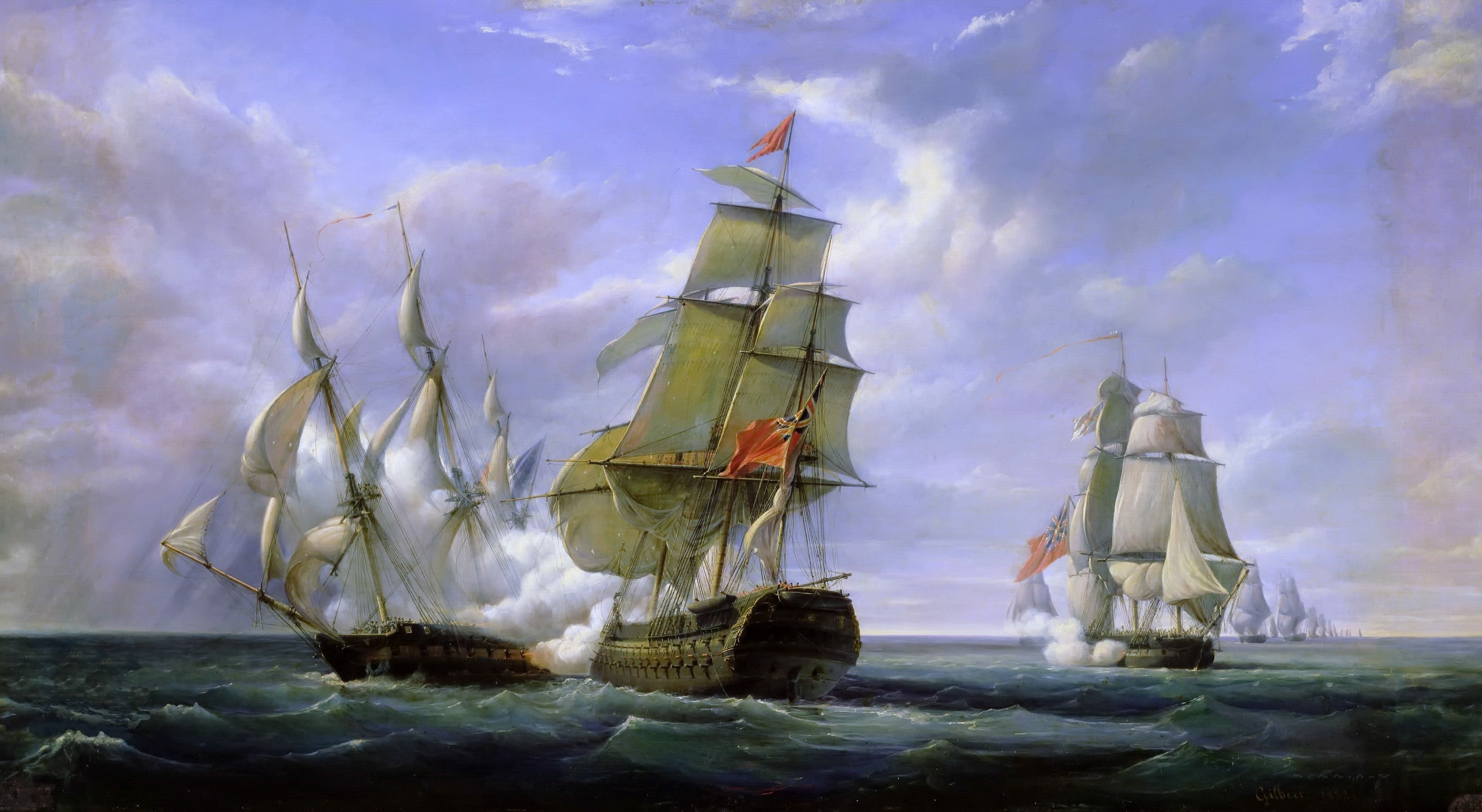
[Right: A Ganges-class ship, to which HMS Minden belonged, at war with French Navy in 1806.]

The national anthem, which originally was a poem titled "Defence of Fort McHenry" was written by one Francis Scott Key. Mr. Key, a lawyer by profession, was visiting certain British officials at Royal Navy ships at that time.

The point in case here is that the ship HMS Minden, a Ganges-class ship, aboard which this national anthem is first conceived and written was Made in India. The ship was built by one Mr. Jamshedji Bomanji Wadia, a merchant of Bombay. And by this account of trivia, the Outsourcing relationship, as it were, between the US and India is as old as 1801 when this ship was first built at Bombay dockyard, one of the best ship-building dockyards of the world at the time.

Happy 4th of July!

And, to quote Jefferson's famous preamble for the Declaration of Independence on this day in 1776:
We hold these truths to be self-evident, that all men are created equal, that they are endowed by their Creator with certain unalienable Rights, that among these are Life, Liberty and the pursuit of Happiness.

On a lighter note, below is Happiness with a 'y':

[Above: A scene from a spirited portrayal of "American Dream" in this 2006 Hollywood film "The Pursuit of Happyness" based on the true life-story of Self-made American millionaire businessman and stockbroker Chris Gardner. Will Smith plays the lead role. Smith has also played the Hero in the sci-fi "The Independence Day" of 1996.]

Thursday, July 03, 2008

Who Pockets the Extra Money I Pay For Gas?

THERE IS NO PLACE CALLED "KING ABDULLAH ECONOMIC CITY" in the world as of now. But perhaps it wouldn't be long before we see a spot on Google Earth with such a name having 3 million in population, partly thanks to the sky-rocketing Oil prices.

Interesting Headlines: "The Crude At Rude Prices"
and
"Oil Crises called Oil Prices"
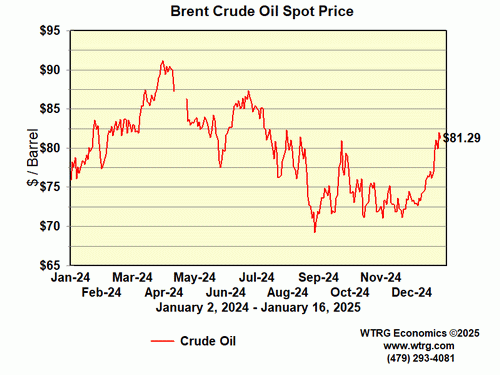
The crude prices reached a historical record USD 145 per barrel - nearly doubling compared to the previous year. A barrel holds 42 US gallons or about 159 litres of crude oil, making it USD 0.91 for 1 litre - almost double from USD 0.44 per dollar last year. This is the purchasing price of crude oil from the OPEC countries, and is not yet usable. The actual process is much more complicated, but at a very high level, it follows steps like transport it, refine it, process it, transport it again, store it, distribute it and make available at the local gas station. This adds additional costs to the original purchase price of Oil. Traditionally, the total production cost and profit on top with added government taxes becomes the sale price of the product to the end-consumer. However it may not work in that fashion all the time - countries like the US purchase crude at a different (lower) price from the market, and countries like China and Malaysia subsidise the product to bring the retail prices within consumable range for the common people. But then, beyond a point no government with the right economic policies would be able to insulate the global economic pressure of the price-rise. It is rather a misnomer that India subsidises gas and diesel. Consumers in India pay more for litre than the selling price of the Oil companies by the way of additional tax by the government.

[Above: Doubling of crude oil prices over past 366 days. Source: wtrg.com]

This is the good or "light" crude that is getting costlier. The world at large has the capacity to refine this rather crude product into usable Gasoline, Diesel, etc. Increasingly, many oil-wells have started drawing "heavy" crude for which the Oil companies worldwide have limited refining and processing ability. Oil processing giants like Reliance Petrochemicals is in the process of constructing world's largest oil refinery in India with a huge capacity of processing both "light" and "heavy" crude, but it would take a couple of years to be fully functional. The so called shortage of light crude might have put the crude prices under pressure, but by no equation it could make the prices go double over the previous year.

Furthermore, if someone argues that the Demand of Oil has grossly and suddenly outpaced the Supply, and that is forcing the Oil prices to rise, you are being taken for a ride. The demand is supposed to be well in sync with the production. It is the supply-chain that has gone for a toss, and by a certain account a suspicious mind might smell a mischief at work.

I suppose it takes only common sense to pose the question: the extra money that I am rather forced to cough up for every litre at the gas station, where does it go after all? It must be ending up into someone's pocket... There must be somebody who is accumulating a rather handsome capital in this fashion from around the world! And, there are a couple of possibilities:

In a very interesting documentary last month the BBC correspondent visited this once barren site where construction work is going on at a fanatic pace in the deserts of Saudi Arabia. The contractors, such as the Bin Laden Group, are trying to convert the uninhabitable sandy planes into King Abdullah Economic City which is one of the six of its kind - making it one of the largest desert reclamation project in the world.

[Right: The city in Saudi Arabia that consumes a major portion of a billion dollars of revenue every day that the Saudi Arabs acquire by selling oil to the world at a doubled price.]

It is reported that since they have doubled the crude oil prices, nearly USD 1 billion is pumped every day into the building of such cities by the Saudi people; the money that Saudi Arabia, the largest oil producer, acquires by selling crude oil.

[Related post: Oil Money Powering Windmills]
[Go here for the BBC story on the Saudi city and how they make/spend billions a day from rising Oil prices.]
[Go here for details about the controversial oil company Zapata Corporation founded by President George Bush, Sr.]
[Go here for a Bloomberg story on the "world's largest oil refinery".]
[Go here for an interesting article titled: Perhaps 60% of today's Crude Oil Price is Pure Speculation.]

Friday, June 27, 2008

So Long, King Gates

FINALLY, THE IT TZAR TAKES THE BACK SEAT. And as Mr. Bill Gates completes his last full working day by the EOD today - June 27, 2008 - at his Richmond, WA office in the US, an era of Biggest, Richest, and Fastest draws towards a change. Call him Innovator, Software Evangelist, Chief Software Architect, or by any other name, above all, Mr. Gates is a successful businessman, Zero-to-billions kind. And that is how I would want to reckon him, for Mr. Gates is not perhaps a mesmerising orator, neither a charismatic leader, nor a magnanimous personality. Even if he is all of these, they rather remain secondary, for the bottomline is, Mr. Gates knows business, does business and means business. Period.

Arguably the world's most famous dropout - and thus perhaps the tallest example that education and money may not have a direct corelation - wrote the first BASIC compiler 17 years ago, and left the legacy as the world's richest man with such words: "There is nobody getting rich writing software that I know of...".

[Left: Bill Gates, CEO, about 27, in his Microsoft office in 1982. Source: time.com. Do you also feel that the DOS screen in front of him reads something very similar to "Bad Command or File name?"]

Mr. Gates indeed has been the biggest catalyst for last two decades for the IT industry and for the global economy at large - Windows OS still runs more than 90% of personal computers in the world, and Microsoft Office artefacts are the de-facto standard for offline information and data transaction. This has made Mr. Gates the richest man on earth; reaching there in the fastest possible manner - at the speed of thought, if you like...

On my part, it was a wonderful experience to listen to him from a mere few feet away in Sep 2002 while he was delivering a lecture and providing with his vision (such as, "XML is the future...") at the time of the launch of Windows XP. It being my first encounter with a global leader at close proximity left me with a lasting impression.

Competition has not been kind to Mr. Gates, and visa-versa is probably equally true. Sort of a reminder of the old saying that Friends come and go, enemies accumulate...

The success of Microsoft Corporation undoubtedly has contributions from many more than Mr. Gates and his "Big Picture" memos alone, but in the world-wide (Globalization?) game of business where media and economy are increasingly tying up, and where winner takes it all, the credit nonetheless has almost always been attributed to Mr. Gates as the poster-boy face of Microsoft. At the same token, the discredit of bad designs, security flaws and sloppy software performance is also to the discredit of Mr. Gates.

[Right: Culturing Innovation; Sponsoring ImagineCup. Bill Gates in Korea for the event in 2007.]

It would be an interesting experience for Bill Gates to become a user from the owner of Microsoft products. His displeasure towards many thing Microsoft, especially the usability and user-friendliness, has been known. (Here is the full text of a rather interesting and lambasting email supposedly from Gates himself.)

BillG, as they call him, has never faced any job interviews, and in that respect he would perhaps always remain inexperienced! Unless of course any of the prospective next career moves (as in the following video) click for him :-)

Mr. Gates opened his keynote of TechEd 2008 last month with the following video. This is where Mr. Gates tries various career changes now that he is to move out of Microsoft. It has been making rounds on YouTube since Jan this year, and it's honest, well choreographed, very humorous and well entertaining. Not worth missing at all!


[Above: Bill Gates, Last Day at Microsoft. Simply Brilliant! Go here for the YouTube link.]


Bill Gates is going to be just fine whatever new avtar he may adorn next. But the industry observers seem to be divided over what would happen to Microsoft in absence of its poster-boy. I recall a media interview a few years ago where the reporter indirectly inquired about the "Google threat".
Mr. Gates replied and I quote, "Every couple of years a new company comes up and people say that it would put us [Microsoft] out of business. And every time I say, 'No, not this time'..."

If monopoly and monarchy have anything in common, we should shortly hear, "The King is dead... Long live the King!"

Let's see who would stand up and say "No, not this time..." for Microsoft next.

[Go here at time.com for the Photo-essays on Bill Gates' early days.]

Friday, June 13, 2008

"The Beautiful Mind" Turns 80

"The special commodity or medium that we call money has a long and interesting history. And since we are so dependent on our use of it and so much controlled and motivated by the wish to have more of it or not to lose what we have we may become irrational in thinking about it and fail to be able to reason about it as if about a technology, such as radio, to be used more or less efficiently..." -- John F. Nash, lecture at CII in Mumbai, Feb 2007
IF THE WORLD IS CONSIDERED A "CLOSED SYSTEM", deeming it a Zero-sum game, Nash Equilibrium could certainly offer a different meaning to the notion of money, and thus, to the word richness or net-worth and the world economy.
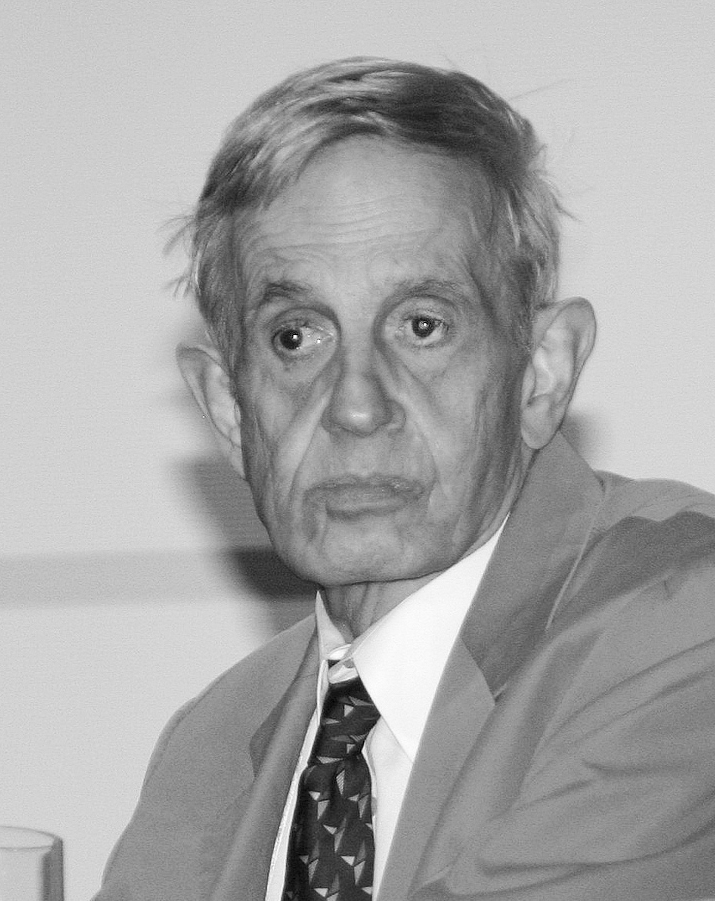
[Today, June 13, John F. Nash, Jr. turns 80. A humble tribute to the 1994 Nobel Laureate legend.]

Arguably, the Nash equilibrium is the single game theoretic solution concept that is most frequently applied in economics. In terms of strategy and planning, the equilibrium could be simplified as:
"For any finite, non-cooperative game of two players or more, no player can improve his/her pay-off by unilaterally changing the strategy..."

[Above: Actor Russell Crowe in his Oscar winning portrayal of John Nash in the 2001 Hollywood film A Beautiful Mind.]
  • See also:
  • Go here for Nash's personal home page at Princeton.
  • Go here at Investopedia for the investment perspective of the theory.
  • Photo courtesy: Prof. Lynne Butler.

Wednesday, June 11, 2008

ImagineCup 2008 - Runnup

"Achieve What You Can Imagine." --imaginecup.co.uk

invention, innovation, inspiration, imagination...

If any of the i's tantalise you, entertain yourself with this cute little 1.5 minute teaser video, which in fact is a runnup to the ImagineCup 2008 due this month.


"Great innovators don't imagine things in the future;
They imagine them in the present,
and change the future..."

Go here for a list of Software Project designs that made it to the semi-finals of the innovation competition this year.

[The video above is one among many created by the students of Ravensbourne College of Design and Communication. Go here for the video on YouTube, and here for other possibilities from Microsoft.]

Edit: The '08 finals will be held in Paris between July 3 and 8, 2008.

Sunday, June 08, 2008

Clinton bows out of the race to the 'White'house

Yahoo: Clinton suspends campaign, endorses Obama.

And now, it is 'young' Barack Obama pitted against 'experienced' Mr. McCain.

Let's suppose that Senator Obama continues the momentum, wins over the Clinton vote-split, manages to prove that young is the new 'old', defeats the myth by showing that change could also be other than what is loose in your trouser pocket, and finally makes it to the 'White'house, should he rename it?

[Above: Girls from Obama village in Japan dancing for Barack Obama's campaign.]

Talking about names, I am almost certain that it is purely coincidental that Baraq Obama sounds so similar with the two other major disasters for the Bush Administration: Iraq Osama

Edit: Oh, by the way, Obama's middle name, through his Kenyan father, is Hussein - as in Saddam Hussein...

Thursday, June 05, 2008

The Green Wall of China

TODAY, JUNE 5, IS THE WORLD ENVIRONMENT DAY.

It is an open secret that China is the biggest abuser of environment in the world. Most of the manufacturing in China uses coal-burning furnaces, and that one single industry equals more than the most the whole of Europe in terms of CO2 emission.

At the same time, China is the single largest country to have invested the most - USD 8 bn - into planting trees. Criticised yet again though it is doing some serious spend, the reason is rather different from a change-of-heart or accountability or even a soft-corner for environment. Beijing, its capital is being subjected to sand storms so frequently that the Chinese have already coined a term for it - Yellow Dragon. Sand from this area have already started crossing the Pacific and reaching Americas.

[Above: an artist's impression of the Green wall of trees stopping the Gobi desert in its tracks.]

This is the Gobi desert from Mongolia making inroad into China at an alarming pace - claiming 3,600 km² of Chinese grassland per year and converting it into a desert, and creating "sandy" environment all over the place. The denting Chinese economy by nearly USD 50 bn every year. To check this dangerous progress China has finally decided to hug the trees, and we have the (great) Green Wall of China - the largest afforestation project in the world today.

The Green Wall is a project to plant a 4,480 km (2,800 miles) shelterbelt of trees across the North-Western rim of China skirting the Gobi Desert. To avert the ghost of de-forestation, this afforestation project is phased for next 70 years starting 2001.

Better late than never...

[Go here for a related coverage by BBC.]

Monday, June 02, 2008

Warne Lifts Maiden IPL

A COUPLE OF MONTHS AGO I was sitting over the fence of 80% and 20% of the opinion makers reacting to the possibility of success of the IPL business model. 80% were the sceptics and believed that as it happened with ICL (Indian Cricket League – Chaired by Kapil Dev and sponsored by Zee Entertainment), IPL would find very few takers – perhaps only the useless of the useless lot would devote time to this remix masala version of the gentlemen’s game. To my mind, both these Indian T20 “cricetainment” versions were not at par: ICL was but a “zee thing”, where as the Premier League had the mind, money and muscle backing of BCCI – an important element that could make it swing and bounce.

[Above: Team Jaipur after winning the maiden IPL. 1 June 2008. Source: http://ipl.indiatimes.com]

It appears that this compressed format of the game may not have gone down too well with all quarters of the cricket, especially the British media and "empirical" standards. Lord Archer, for example, has been quoted saying during his hugely successful India tour last month that Twenty20 is entertainment and not a cricket. Lord Archer may offer a dead defensive bat, and silly mid-on and Shane go up in appeal to Billy nonetheless, the whole of the stadium also erupts in asking the same question. That essentially is the appeal of the game. Spectacle.

Twenty20 is not going anywhere, and while the possessives (or the hypocrites like Ponting who, after getting a hefty pay-cheque for just a couple of appearance at IPL, goes back to leading the test squad and condemns the T20 format), cling to the ‘real’ word for Cricket, the economics are hugely against them. Fundamentally, I tend to agree that the game is played for the honour and patriotism, and that motive is now being played now purely for money. And the players are like hired "mercenaries" in certain cases. But sport, as much as it may be for the spirit, is also about entertainment, and while the contemporary youth is on a fast track for almost everything in his life, let T20 be a door for him to enter and sustain interest in Test Cricket. Let the format have best of both the worlds of English Premier League Football and American Baseball. While visiting the US I found it very difficult to convince my American boss that there could be a game that goes on for five days. Worst still, people go and watch it! Now I have something for him to relate to with his favourite Baseball team - LA Dodgers. (And then, there surely were some American cheerleaders around.) Let’s say that a Test match is like a grand five-course unlimited dinner, compared to which an ODI is like a limited lunch, and so T20 is but a quick snack or a breakfast. Having said that, the likelihood of T20 eating into the limited format of the game (ODI) is pretty strong – a brunch, if you like. (Did you hear also or is it only me that they are thinking of renaming BCCI? The new name got to be BCCCI - Beware of Cricket Crazy Countrymen of India.)
[Right: Washington Redskins cheering for IPL in Bangalore. Apparently, Bangalore Royal Challengers had "Bangalored" that job to the US.]

I suppose it was Geoffrey Boycott who, while commenting during India's tour to England, first put forth the point that ODI is a Batsman’s game, for all the rules are against the bowlers regarding what they could do, and more importantly, what they can’t. The situation just got worse, and we have Twenty20 where the bowler is to be slogged. Or that’s what the initial impression was. It turns out, such is not the case, for all the important games did a turn-around mid-course because of some very clever bowling – be it Mumbai Indian’s ouster from the IPL because of a sad last over finish, or be it “Balaji – the weak-link” for Chennai Super Kings whose rather stupid last over did them in and they lost the trophy. (It was a rather modest Dhoni, with his first-time-on-TV huddle of his team on the ground before getting into the dressing room after the defeat in the finals, that he said it was a team effort, win or loose, and there was no one single event or player to be singled out or blamed for. A leadership quality that better not be lost on the likes of the "legendary" Tendulkar who, rather curtly, passed the buck of loosing out of IPL to the Sri Lankan Dilhara Fernando who bowled that last over.)

BCCCI - Beware of Cricket Crazy Countrymen of India...
Warne’s squad was considered an underdog on the ground that they didn’t have any star player (and where of the cheapest bidding of the eight during the auction). Somehow, I disagreed with that statement. Rather I considered Jaipur team a real good value-for-money for the bid-winners. Warne is no less than a legend in his own right, and when you have the captain of the South African team also as your opener, you surely have a side to reckon with. If at all someone would want to consider them as starting underdogs, the reason has to be that the total squad didn't had the best of the commercial value at the bidding time. And then again it was the error of judgement on the bidder's part then anything else (one more indication to this effect is that Anil Ambani is rumoured to have backed out of Royal's bidding at the very last moment for Ahmedabad, and the team was won by Jaipur). The real important part, however, was the captaincy by a leg spinner: IMHO successful spinners are born tacticians; shrewd and deceptive in their strategy and their main weapon. This may not be the case with the fast-bowlers who depend on their physical strength for pace more than anything else. Warne’s so-called "role-based approach" to the game might have given him the first IPL success, but it would be extremely difficult for him to repeat it in the comings seasons, and I am almost certain that he is also aware of it.

Some Trivia and Not-so-trivia about the IPL - maiden season:
  • The broadcast rights for IPL for India were sold at USD 1bn.
  • Before the tournament began, even 90% of India was unaware of a Cement brand called Super Kings. Wikipedia had no mention of India Cements Ltd. In 45 days, Super Kings goes on to become a globally known name and brand, and like N. Srinivasan, CEO, puts it, every penny invested in the franchise by them is worth it - No other branding strategy could have delivered within the given time-frame.
  • Delhi Daredevils had the best ROI with their Feroz Shah Kotla ground turning in nearly Rs. 90 to 100 million in gate collections. They are the first franchise to break-even and go profitable.
  • For Shah Rukh Khan, it was a double loss: first, Kolkata lost out, and then the TPR of IPL ate heavily into his newly launched game-show "Panchvi Pass". He is surely praying for the revival of both.
  • Vijay Mallya remained at the receiving end as Royal Challenge as a brand also goes down with his IPL team, and Blender's Pride (Seagram) takes over the #1 spot in sales - almost after a decade.

Sunday, May 25, 2008

Ken Harvey, the "Richest" CIO

KENNETH M. HARVEY AT HSBC HAS HAD A LASTING impression of an IT leader for me. And I believe in the capacity of a corporate executive, 'richness' (see: Money) has more to do with quality of role, thought leadership and budget at disposal. In all of these terms, one might wager, Ken Harvey indeed must be a very rich man, for him being the group CIO of the world’s largest organisation, and then having a whopping USD 5bn in terms of his annual spending budget.

It always felt great to conclude my induction sessions for the newly joined Business Analysts in my team by saying, "While certain organizations (vendors) aspire to make millions every year, Ken plans to spend in billions..." It rather gave everyone, me included, a sense if you like, of having a bundle or two of "cash" from Ken's kitty into our pockets.

I specifically recall Mr. Harvey’s discussion with the Gartner members where one of the panellists posed him with the question of the challenge of keeping motivated the global workforce of nearly 25000 IT professionals. What Mr. Harvey replied is pretty interesting. Mr. Harvey suggested that the workforce worldwide is like a huge diversified but united team where:
"The out-of-box ideas come from my California office, for planning I give it to my London office, and for execution, it is my Asia (HK/India) office..."
While the lion's share of the budget goes towards the 2 tbps dedicated worldwide network that the bank privately maintains under "run-the-bank", the "change-the-bank" quadrant still attains a hugely sizeable amount for the change-agents (like myself!). And then, spare a thought for the contribution this 5 bn makes annually towards the IT economy worldwide, and also to the net-worth of individuals... For the record, I am quoting Mr. Harvey here that he would want to maintain a list of no more than a dozen suppliers and vendors... Statistically, the sum of 5bn in itself is more than the annual GDP of many countries worldwide (and could perhaps make for an outright buyout of a few islands in the Pacific). On the other hand, we are talking about only a handful of IT service providers splitting the billions among themselves. And this spending is sustained whilst the market is feeling the sub-prime heat.

But then, Mr. Harvey never said it would be easy: the bank commands some of the lowest billing rates from IT providers in the industry, the roles are stretched to the limit of imaginations, and requirements happen and change as dramatically as the Hang Seng index of Hong Kong stock exchange which practically runs on Mr. Harvey's servers.

[Right: HSBC corporate HQ building at Canary Wharf, London when viewed from Narrow Street besides Limehouse Basin. Source: self]

Here is some indication as to how Mr. Harvey planned about spending USD 5bn. And here is a Reuters report suggesting how it finally paid off.

Update: As of 2008 HSBC merged operations with IT under its 'One HSBC' strategic initiative. Mr. Harvey was appointed as the President of the new initiative.
  • See also:
  • Go here for the Sep '08 official announcement of Ken Harvey becoming the Chief Technology and Services Officer at HSBC Group.
  • Go here for the official Executive Biography page of Ken Harvey on HSBC website (pdf, Jan 2010)

Saturday, May 17, 2008

Statistically...

AT TIMES IT SEEMS impossible to not to include statistics in my analysis while making a proposal for a client or to the higher management. This is also at the cost of pure brilliance of a point that need to statistical support but is rather a marvel of common sense.

Statistics and sensibility are supposed to be the right mix. Statistics are to be handed to the right personal, at the proper time and format, to be utilised in the appropriate manner in aid of the point rather than being the point themselves. This seldom becomes the case nowadays. I couldn't help but mutter to myself at such times the following:
"Statistics are like a lamp-post to a drunken man - more for leaning onto than for illumination."


Saturday, May 10, 2008

Business Development, Pre-sales, Sales and the 'Arrow-head'

HAVING BEEN TRAINED FOR CULTIVATING 'GROWTH' AND evaluated for a few appraisal cycles by now for tasks that were marked under a title called 'Business Development' (or something that either sounds or seems similar), the debate on the subject by a certain groups of 'experienced' personnel almost immediately drew my attention.

And it becomes interesting when, with all due respect, the so-called experts, having built their careers in the relevant fields, seemed rather confused between the functioning and mandate of 'Business Development' and 'Sales' functions. Before taking a dig on that, respectfully, here is my version of the 'classical' definition (or differentiation) of the two:
"Business Development is a bunch of activities of today, based on your strategic vision of your product/service framework, that the Sales people would be selling tomorrow."
Well, this definition might neither be universal nor be entirely technically accurate. However, it does give a certain level of clarity (when some of the rather experienced folks are contributing to the confusion). To me, these two functions are neither the 'same' nor 'interchangeable', but are distinct. And by the virtue of that clarity one can perhaps define both the functions more accurately and also appreciate their imperatives.

So, what we are saying here is - today's Business Development initiatives could (should) potentially translate into sales targets of tomorrow - in other words: Sales follows Business Development. And thus, what we call pre-sales will have to fit between the two where it would have a sort of a 'vetting' role for the tasks trickling down from BD for the Sales to be made. It perhaps is a different matter that all of these three functions may not exist independently for a given organization, but could be merged among each others (pre-sales may be merged with BD, or BD may be made to co-exists in the same basket as of Sales. And that perhaps is the very reason where the confusion about the distinction is arising from).

[Above: The 'Arrow-head' components: a) the Sales function as the cutting-edge, b) the Business Development (BD) function, the main-body, that gives the aerodynamic shape and (thus) 'direction' to the arrow, and c) the Pre-sales function that embeds the Arrow-head to the stem (delivery streams).]

My personal exposure to these "cutting-edge" functions has been in terms of IT systems services, products, and delivery (where I have had the opportunity to performed all the roles except for direct-sales). In terms of the required skill-sets and experience for each of these functions: a BD professional might have to have a more strategic (and, if I may add, visionary) inclination on top of pure selling skills. A pre-sales professional, at the same time, may have to have a more Risk-oriented outlook (the correct Risk-appetite measure, as well as Risk-averse functioning) and the mandate to have Risk-mitigation embedded within the Sale that is going to be made. This is also the position where the 'Analysis' bit could play its role. And connect the "arrow-head" to the structural strength of the stem (delivery streams) which provides for the momentum for the 'travel' (i.e. growth).

Further, this also helps give the logical alignment of each of these functions vis-a-vis the leadership roles in a typical organization. The BD function should ideally be with the top executive leadership (CEO/COO); the Sales function should report into BD; and the pre-sales should be closely knit with delivery/operations and having a dotted-line reporting to the executive leadership.

Go here for the interesting 'confusion' that I referred to at the beginning (you may would want to skip the vanity of the thread at the start and move over to the answers).

Wednesday, May 07, 2008

Cheers! to Life...

Cheers!

To

The Many Faces

in Life

of Life

as Life

That Makes

a Life


* * *
When old words die out on the tongue,
new melodies break forth from the heart;
and where the old tracks are lost,
new country is revealed with its wonders.

--Rabindranath Tagore,
Gitanjali (1912), pp37.


Today, May 7, is also Tagore's Birth Day.

Saturday, May 03, 2008

My Net-worth is in Millions Already!

WOULD YOU LIKE TO BE AMONG MILLIONAIRES? If you are in IT in India, perhaps you already are!

First, some bullet-points about the global and Indian IT industry that got me thinking:
  • Indian Software Industry is approx 66% of Worldwide Software Services
  • Top 6 Indian IT Companies makes of approx. 50% of total Indian IT Industry
  • In terms of sales among these top six (in descending order of reported figures for 2007 - TCS, Wipro, Infosys, Cognizant, Satyam, and HCL), the first three clocks almost 60%
Now, a Forrester Research forecast reports says that the total Global IT spend (IT industry potential) is projected to be at USD 1.55 trillion in 2007-08.

Wow! A quick back of an envelop analysis reveals some pretty interesting monetarily figures. (above: rather front of the envelop; the back was already taken by the groceries' list...) Enjoy:

Global IT industry at USD 1.55 tn (2007)

66% of it is served by companies in India

50% of which is with the top 6 players of India
i.e. 33% of global IT services business is with 6 Indian cos.

About 7% of Global IT business is with Infosys
and
they have about 70k employee-base

therefore, an Individual net-worth could be 7/70,000 = 0.00001%

applying a multiplying factor* p @ p = 3.5
0.00001% x 3.5 = 0.000035%

net-worth of 0.000035% of Global IT business

my net-worth could be 0.000035% of USD 1.55 trillion
=> USD 1.55 tn x 0.00000035 = USD 5425000
=> approx USD 5.5 million


* To account for the disparity of "value-add" across various levels and roles in a given organization and in the industry at large, let me introduce a 'premium' factor p, which takes into account factors such as experience, longevity and loyalty, value-add-over-tradition, client-relationship-quotient, niche skills/domain knowledge, roles/management abilities, innovations/leadership demonstrations, reputation/recommendations/published papers/blogs etc., I-am-the-best-attitude, and alike.

As the base, a 'pure' and productive software engineer in Infosys would have her contributions to the industry measured at p = 1.

For my p factor, I have considered value 1 for 10 years of industry experience, 1 for effectively delivering in client-relationship and value creation (business development) roles, added 1 to it for venturing into and bringing back 'goodies' from unchartered territories (business development, and successful greenfield projects), and 0.5 for doing more than 3 years at Infosys (longevity and loyalty), which makes my p = 3.5.

And, in terms of the Global IT industry, that brings my current 'Professional' net-worth at USD 5.5 million!

Now, that 'Feels' good!

How much is your worth? Aren't you a millionaire yet!

[For relevant Forrester Research forecast for 2007-08, go here.]
[For the corresponding NASCOMM story of 2007, go here.]
[For
Forbes.com report on Ambani's 'costliest home in the world', go here.]

Edit:
Go here for npr podcast putting "Value On Life" at USD 6.9 million in 2008, which is a depreciation of nearly 11% over past five years.

Sunday, April 27, 2008

A "Revo-lulu-tion" in Print Publishing

ANYONE WITH A SOMEWHAT SERIOUS SLANT towards one's blogging lines would want to publish something in a physical paper format (read: book) at some point in time. At least that is what my general observation has been. On one hand, while the technology of bringing words online in the forms of Blogger, LiveJournal, MySpace and alike have made content creation a one-click job and in doing so might have taken the 'authors' away from the traditional book-publishing process, on the other hand it is really interesting to see how the same technology loops back and makes publishing a book in paper format an equally user-friendly and accessible experience. Add to that the ability to enable Creative Commons options, variable pricing options, and manufacturing (physical printing on paper and binding) and shipping on-demand, provides the new dimension of flexibility in the hands on authors. This is the modern technology looping back to aid the traditional medium of publication rather than clipping it.

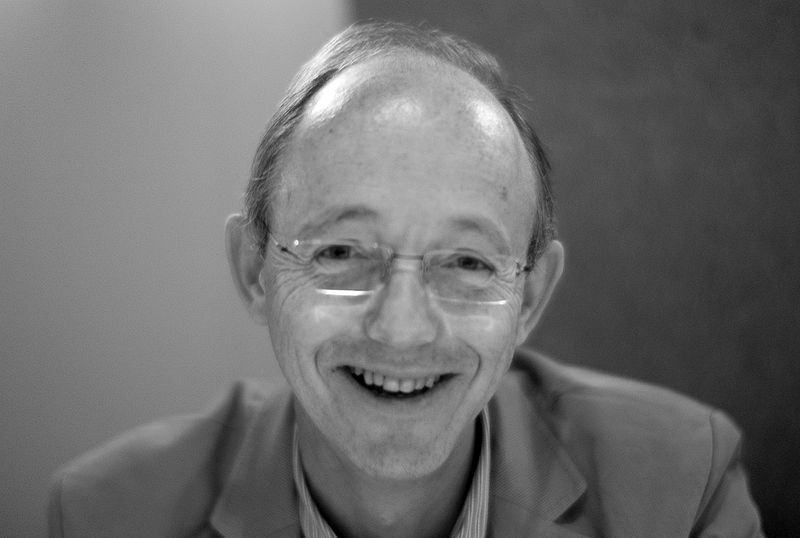
The concept first came with Bob Young (co-founder of Red Hat Linux) and Stephen Fraser when they founded lulu.com - winner of 2007 Web 2.0 awards, and arguably, the largest print-on-demand service for books in the world at this point.

[Above: Bob Young, Co-founder of Red Hat. Aug 2007]

The cook-book about publishing your book through lulu is readily available on the site, and is rather straightforward. One can also provide custom-made front and back covers for the to-be-printed book. The content could be a simple word document which would be converted and formatted by lulu automatically as per requirements. (The structure of the uploaded document/book should be in one of the prescribed format.) One can easily buy an ISBN number as well for the work to be published.

"Write your book at [the age of] 40, but dream about it for at least five years..."
I got this thoughtful advice recently from someone I like to trust and respect: "Write your book at [the age of] 40, but dream about it for at least five years..." So, even if it is not time yet for you to start publishing (and making money out of what you write!) I suppose it is still always worth-while to open your 'storefront' on lulu that 'sells' your book(s). You may stop by my store on lulu. It is still empty though, but you may would want to keep a watch on it! ;-)

  • See also:
  • For an interesting interview of Stephen Fraser by Creative Commons, go here.

Friday, April 25, 2008

Crowded 'Facts'

Crowded 'Facts':
"I consider that a man's brain originally is like a little empty attic, and you have to stock it with such furniture as you choose. A fool takes in all the lumber of every sort that he comes across, so that the knowledge which might be useful to him gets crowded out, or at best is jumbled up with a lot of other things, so that he has a difficulty in laying his hands upon it.
Now the skilful workman is very careful indeed as to what he takes into his brain-attic. He will have nothing but the tools which may help him in doing his work, but of these he has a large assortment, and all in the most perfect order. It is a mistake to think that that little room has elastic walls and can distend to any extent.
Depend upon it - there comes a time when for every addition of knowledge you forget something that you knew before. It is of the highest importance, therefore, not to have useless facts elbowing out the useful ones."
-- Arthur Conan Doyle (Sherlock Holmes)
Quite interesting it is that the same context, when applied to the premise (mind attic) of Business Analysis, holds equally true. It is the weeding out of 'useless' facts from the assortment of information is what makes of an effective analysis.

The cryptic puzzle of 'The Adventure of the Dancing Men'
Learning to Observe:
"Like all other arts, the science of deduction and analysis is one which can only be acquired by long and patient study, not is life long enough to allow any mortal to attain the highest possible perfecting in it.
Before turning to those mortal and mental aspects of the matter which present the greatest difficulties, let the inquirer begin by mastering more elementary problems. Let him, on meeting a fellow-mortal, learn at a glance to distinguish the history of man, and the trade of profession on which he belongs.
Puerile as such an exercise may seem, it sharpens the faculties of observation, and teaches one where to look and what to look for."

-- Arthur Conan Doyle (Sherlock Holmes)

It is much telling that the century-old master analyst has termed 'science of analysis' as an art.

Wednesday, April 23, 2008

The Bard's Birth Day

April 23 - TODAY BEING ST. GEORGE'S DAY is also considered to be the Birth Day of William Shakespeare. (Nobody knows for sure of the bard's exact date of birth.)


If one wonders about the alchemists of that era, and if they would have got a couple of 'immortality' pills of which one was taken by Shakespeare such that he would still be alive at this time, what kind of blogs would he be maintaining..?

Perhaps a blog with the highest hits on the net!

Footnote: Sampling only Technorati may perhaps be a rather narrow view, but looking at their popular index stats available of top 100, the most popular blog as of this moment is - The Huffington Post, closely followed by (my personal preference) TechCrunch. (Well, by including weblinks here, I just contributed one more point to the 'authority' count on Technorati for both.)

Sunday, April 20, 2008

"Fred the Shred" under the weather?

THEY CALL HIM "FRED THE SHRED...". If you count "few good men" who took the lead in the "rationalisation" of workforce in the conservative European banking and Financial services, Fred has to be in the front row.

Sir Frederick Anderson Goodwin, remained in the news in Europe, mainly Britain, for his often visionary yet unorthodox methods of running Britain's second largest Banking group. After he assumed control, the RBS groups, perhaps for the first time, saw a rather American-styled cost-cutting, or Shredding as the Britons prefer to call it.

Managing nearly 1000 people worldwide at the age of 32, the acumen more than the aggression made Fred the CEO of the Clydesdale Bank at the age of 36. He has been quoted as famously saying, "I have no time for cynics, spectators or dead wood". And as we speak, being with the RBS group, he is the longest serving CEO in the FTSE-100 index. (That precisely makes me wonder if the pool underneath is in a pull-down mode...)

Knighted at the age of 46 for his services in Banking in 2004, the RBS group saw its highest ever rapid inorganic growth since Fred was brought in by another Scot and the then Chairman of RBS Group, Sir George Mathewson. Whilst being at a couple of bids of hostile acquisitions, he has been quoted saying, "There may be some possible mercy killings".

Chosen as the "Businessman of the Year - 2002" by Forbes, Fred began with the humongous acquisition of NatWest in 2000 with unusual amount of due diligence of nearly 500 man-days, and the latest is acquiring of ABN AMRO for about Euro 70bn by the consortium let by RBS Group. All in all, in last nine years that Fred has been with the BRS group, their 'shopping list' lists 26 buy-outs at the value of GBP 33bn (about USD 66bn).

[Above: (L-to-R) Maurice Lippens, Executive Chairman of Fortis, Jean-Paul Votron, CEO of Fortis, Fred Goodwin, CEO of Royal Bank of Scotland (RBS), and Emilio Botin, Chairman of Spanish banking group Santander Central Hispano (SCH) in Edinburgh, Scotland, 10 August 2007, at the time of acquisition of ABN AMRO by the BRS-led consortium.]

"I have no time for cynics, spectators or dead wood..."
It is that time in the turning wheels of world economy that the Citigroup reports a loss of USD 5.1 bn, and the chairman of UBS already fallen on his own sward, Fred is equally under fire for (yet undisclosed) rights issue coming from RBS for nearly GBP 9bn.

It is perfectly all right, I suppose, that there are other, younger, aspiring 'leaders' waiting in the wings to take command, the aegis of Fred and the likes has to be honoured nonetheless; for what it is - the aegis; though you may also count those rather "dodgy deals" that Fred supported for the sake of "business" at "huge" environmental costs in the Oil & Gas sector... (See also: The Green wall of China)

Update: Fred took an early retirement in October 2008, following the financial disaster, largely through AMRO deal. Later RBS reported a loss of GBP 24bn, and was subsequently Nationalised by the UK government. In Feb 2009, taxpayer ownership of RBS was between 75% to 95%.

Saturday, April 19, 2008

Oil money powering windmills

WINDMILLS WERE A THING fascination, especially in the farmland of picturesque Europe, more so perhaps because they spoke of a bygone era that I felt I just missed. To much delight, the winds continued to blow in their directions, as it were, and the windmills kept going around. With time, however, as the water-table got deeper and deeper, the Netherlanders found other ways and means to keep them spinning, namely, Electricity generated by turbines spinning by the winds. And I would say, this is a niche electro-mechanical engineering field - building a very energy efficient and 'light' turbine, such that the winds can spin at, and at the same time it gives sufficient torque to the dynamo to create electromagnetic charge that could be refined as usable domestic electricity. And along with all that technical things, the ROI turns profitable within reasonable metrics (and also, that we don't end up having a dog catching its own tail).

Now, so far there was no direct conflict of interest, if you like, between oil-burning (read: automobiles) energy devices verses electricity generation using water-spun, coal burning or nuclear turbines. And while saying that, I am choosing to ignore that portion of energy consumption where European and American homes prefer to use gas instead of electricity for domestic heating in the winter. I appreciate that this percentage might be big enough to ignore, but let's keep it simple here for the sake of argument.

The Oil-man announced at Georgetown Uni to pump USD 10bn to create world's largest wind-farm...
As Al Gore would love to tell you in a dark room with a huge LCD projector - both of these 'consume' natural resources, which are not renewable. And (to some degree) he is right. Unfortunately, the Earth could host only as many dinosaurs as few million years ago to turn them in oil today that could go on and on.

The interesting part begins when the ROI (return on investment: time to turn profitable) for the oil companies starts stretching with every oil well getting deeper, water-source running dry, coal-mines hitting hard-rocks, and atomic energy falling hostage to missile-making men. For them, 'going green' proposes the logical next 'green field'.

The news as it is reported by Reuters today says that Mr. T. Boone Pickens, the legendary Texas Oil Billionaire it 'going green'. The Oil-man has plans to pump in USD 10bn into Wind-energy, and the proposal, which would start acquiring land next month, is to create the world's biggest wind farm. The estimates have it that when those 2,700 wind turbines would eventually generate 4,000 megawatts of electricity - the equivalent of building two commercial scale nuclear power plants - enough power for about 1 million homes.

Mr. Pickens would also want to take the 'pressure off' the automobile sector by freeing up gas by not using it for energy production, but to let it go to those (billion dollar) refineries to pump out gasoline and diesel for the cars. At the same time, also take the pressure off from the American auto manufacturers to be energy efficient (and shake Toyota and Honda off?).

I have come to admire the old Oil-man, not simply for him shrewdly planning for another 'windfall' (no pun intended) of billions, but also contributing to the geographical landscape of North America: Windmills look pretty... Anywhere.

Monday, April 14, 2008

The Gillette 'trap'

[A little background: It had been a few months that I was searching for twin-blade cartridges for the Gillette SensorExcel safety razor that I prefer. I had almost given up on it by now, and was looking towards this seemingly inevitable upgrade to Mach3 or something when I suddenly hit a jackpot - I found a supermarket selling the make and model that I was looking for. I could finally purchase a year worth of supply.

In other words, another year that I would effectively dodge Gillette Mach3 upgrade 'threat'.]

The history goes that some hundred years ago, Mr. King Gillette was a wealthy but frustrated failure of an innovator at 40. He had written a book called "The Human Drift", which argued that all industry should be taken over by a single corporation owned by the public, and that millions of Americans should live in a giant city called Metropolis powered by the Niagara Falls.

His boss at the bottle cap company, meanwhile, had just one piece of advice: Invent something people use and throw away.

One day while shaving with a rather blunt straight razor, the idea struck to him that perhaps this reusable razor could be replaced by a 'consumable' razor having the blade made of thin metal strips. Somewhere around 1870, Kampfe Brothers had developed a forged razor of a similar kind, which Mr. Gillette gladly improvised upon, registered the patent for the new design in his name, and the world got it's first safety razor with name 'Gillette'.

This same successful Business model was the weakness of the Gillette product in the initial years...
The really unique and path-breaking piece about this safety razor was not the product itself so much so was the marketing model it assumed, and which I called - the Gillette 'trap'. Known as "Freebie Marketing", the business model was to give away free safety razors and make profit by selling corresponding blades for them afterwards. In the initial days, however, this marketing model was the product's weakness for the industrial facilities were not advanced enough to manufacture cheap blades with thin metal strips as mass-production. Mr. Gillette had to struggle almost for a couple of decades more to turn his model truly profitable. That past, the inventor is reaping benefits since than, and the company was valued at nearly USD 60bn in 2005 when P&G acquired it to create world's largest personal care and household products company.

The year of 2005 is important for this post also because, after acquiring my new supply of cartridges, I thought of using the one cartridge first that I had been saving for a rainy day for quite some time now. The manufacturing date on this old one is May 2005. But interestingly the retail price is exactly the same as the one I bought today in 2008.

This really got me thinking as to how a product could sustain its retail price for almost three years while inflation is nearly 7% yoy, and the input costs for the cartridges, mainly steel, have jumped (e.g. price-rise in automotive sector). Even a 1-2% difference in prising would have killed the motive of this post, but here we are, with three probabilities:
  • Gillette products were over-priced in 2005, and hence no price-revision took place in last three years. OR
  • Gillette is under price-pressure today, and so is unable to hike prices (and thus making less profit). OR
  • There is a twist in the tail for the "Freebie marketing" model now that there is a new owner P&G is running the show (Also, as critiques say, innovation has already taken a hit at Gillette under P&G - could they simply stop adding more blades to the cartridge and try something really innovative?)

If you come up with a better possibility, do let me know! :-) I would gladly appreciate it if it helps me dodging the threat for upgrade to Match3 yet again...

Wednesday, April 02, 2008

Lama meets Mahatma

I FOUND IT VERY SYMBOLIC SEEING the Dalai Lama paying homage to Mahatma's memorial at New Delhi. And, rightly so. Mahatma Gandhi, who always advocated for equanimity of all religions, was not a Buddhist, yet, without any exaggerations, he was a perfect example of one. Mahatma brought independence to his people through practising non-violence, and that is what the Lama teaches the world.

[Left: Tibetan spiritual leader the Dalai Lama throws rose petals at Raj Ghat, The Memorial to Mahatma Gandhi in New Delhi on March 29, 2008, to attend a public inter-faith prayer meeting for those who lost their lives in Tibet. Hindu, Muslim, Sikh and Jain leaders offered prayers along with The Dalai Lama and hundreds of Tibetans and their supporters at the cremation spot of Mahatma Gandhi. - tiskali.co.uk]

The Dalai Lama is a defacto (though dethroned) King of the Tibetan people. And he is at his Kingly duty while he takes on China with respect to the rights for the Tibetans. In doing so, as always - and as Bodhisattva incarnate - he has taken the peaceful (middle) path, and his 'meeting' the Mahatma was more than a statement to this effect.

On the other hand, there is this 'fraction' made up of Tibetan students, who have taken the route of giving the Chinese military a taste of their own medicine - in an equally violent manner. It's rather natural. But they should be under an effective leadership, and should better know what they are doing, else they would likely end up damaging the mission of the Dalai Lama rather than China. History has it that every peaceful protest or uprising is accompanied by a violent one, and vice versa. After all, not everybody who would want to attain the same aim would consider one path as the only path.

One of the common most dividing range among peoples of all kinds and cultures - An apparent generation gap.

The twist truly comes in the way the 2008 Olympics games are entwined into this ethnic issue. China could have done without it at any rate, but the Tibetans saw a 'global' opportunity to capture world-attention. It appears that they were also backing upon the by now well-known oppressive nature of the rule that China imposes under its regime. A little provocation by a certain bunch of Tibetan students in Lhasa, and China happily obliged by moving in its armed forces. And when it realised that it was rather a lure to the dragon into the cave, it started calling foul on the Dalai Lama for allegedly 'master-minding' the 'violence'. Too late to figure, I suppose.

[Right: Police pull down a demonstrator along the route of the Olympic torch in London. Protesters advocating Tibet's independence disrupted the torch's path in London, Paris and San Francisco. - time.com]

The bad aspect of the Olympics being dragged into this is, as I observed in certain online forums, that it has confused as well as divided people world over in terms of their support to the Tibetans, and in doing so, have lost some good souls to the opposite camp. Someone said, "Keep sports out of it, whatever it may be... [Sports] is probably only place left with some spirit...", Someone else, "Olympics does not belong to China, it belongs to the world, are they [Tibetans] boycotting the world?" another said, "Let's boycott USA for its treatment to the Indians, and Russians for this, and German's for that, and Britons for another, and... You would not end up having any place [wealthy enough] to host Olympics... " These people are generally sympathetic with the oppression that the Tibetans have been through, like they do for Israel/Palestine, Iraq, Darfur, or any other place...

On the beneficial part, the Tibetans gained world-stage to put-up their protests, largely peaceful ones, and attracted the attention to their cause. The media, though it appears remained shrewdly divided, have had multiple field-days. While they 'worded' condemnation for the Olympics boycott-calls, at the same time, they gave certain people and nations the arm-twisting opportunity against China. That said, it is not for the first time that the Olympics face a boycott issue; the world has seen it thrice already. But in all those cases, the issues were international and political rather than ethnic.

[Above: Countries that have boycotted Olympics - Montreal-1976 (yellow), Moscow-1980 (blue) and Los Angeles-1984 (red).]

At the end of the day, however, China would remain unstoppable, and the chances of the Olympics being deferred/called-off and next to nil. And the reason is simple: Economics.

Economics and the numbers involved in this Beijing Olympics event does not favour either deferment or cancellation. Sports is a huge business globally. With all due respect to its international 'community spirit' and all that, the Olympics is after all an economic event of the largest scale in sports today. While it requires a huge investment, it also promises to bring in a mountain worth of foreign exchange within a very short run of about a month. Perhaps, the Bird's Nest has some golden eggs!

China has a lot at stake, for, along with it's investor 'friends', it has infused billions into infrastructure development in/around Beijing to host this event. China's business plans in terms of first breaking even, expand infrastructure at the cost of tourists' money and hyper-consume it's own products in the process, and then make billions in profit, had not accounted for Tibet - Or might have underestimated Tibet, because that's what it seems now. And I suppose that is where China is at its most vulnerable (numbers are not released by China; for London 2012 the budget is £ 9bn = ~USD 18bn). After all, it's all about Money. Threats to Beijing Olympics were first proclaimed by China (not the Dalai Lama, as some media had first reported, and then corrected. The Dalai Lama has rather favoured the Olympics, calling them a peaceful event.). One of the reasons why China had to sound the bugle could be for all those US/EU investors to help cover the grounds. It is supposed to be a very effective strategy if executed properly - let those 'western' investors resist anti-Olympics (i.e. anti-Chinese) propaganda in their respective home-land for the sake of their own invested money.

The Olympics would go on, on schedule, as planned, and we would get to see everyone falling in line as well.

And at that rate, Tibetans seem to lose out; on one hand they could not dislodge the Olympics, they might have made enemies out of innocents, and the 'uprising' remains oppressed. (Also, any uprising has to be from within, and not without.)

This is perhaps the toughest time for the Dalai Lama since his exile. And I hope the Mahatma had a word or two of respite for him...

Update: The 29th Summer Olympics begins with a bang at Beijing on time.