
Tuesday, May 07, 2013
Wednesday, May 01, 2013
The Age of Innocence
 |
| (My junior) |
Noble:
I see trees of green, red roses too
I see them bloom, for me and you
And I think to myself
What a wonderful world
I see skies of blue, and clouds of white
The bright blessed day, dark sacred night
And I think to myself
What a wonderful world
The colors of the rainbow, so pretty in the sky
Are also on the faces, of people going by
I see friends shaking hands, sayin', "How do you do?"
They're really sayin', "I love you"
I hear babies cryin', I watch them grow
They'll learn much more, than I'll ever know
And I think to myself
What a wonderful world
Yes, I think to myself
What a wonderful world
Oh yeah...
~ Louis Armstrong
Real: http://youtu.be/CF3zDhm6EC8
Tuesday, January 01, 2013
Happy New Year 2013
Welcome 2013 as the twenty-first century moves into teen ages.
Season's Greetings,
and Best Wishes.


Saturday, October 27, 2012
George Sugihara On Early Warning Signs
Earlier this month SEED magazine published this very interesting article by George Sugihara, theoretical biologist at Scripps Institution of Oceanography, on how deep mathematical models tie the events of climat change, epileptic seizure, fishery collapses, and risk management surrounding the global financial crisis. Excerpts:
Try here for the full article. The article was originally published on Dec 10, 2010.
[...] Economics is not typically thought of as a global systems problem. Indeed, investment banks are famous for a brand of tunnel vision that focuses risk management at the individual firm level and ignores the difficult and costlier, albeit less frequent, systemic or financial-web problem. Monitoring the ecosystem-like network of firms with interlocking balance sheets is not in the risk manager’s job description.
A parallel situation exists in fisheries, where stocks are traditionally managed one species at a time. Alarm over collapsing fish stocks, however, is helping to create the current push for ecosystem-based ocean management. This is a step in the right direction, but the current ecosystem simulation models remain incapable of reproducing realistic population crashes. And the same is true of most climate simulation models: Though the geological record tells us that global temperatures can change very quickly, the models consistently underestimate that possibility. This is related to the next property, the nonlinear, non-equilibrium nature of systems.
Most engineered devices, consisting of mechanical springs, transistors, and the like, are built to be stable. That is, if stressed from rest, or equilibrium, they spring back. Many simple ecological models, physiological models, and even climate and economic models are built by assuming the same principle: a globally stable equilibrium. A related simplification is to see the world as consisting of separate parts that can be studied in a linear way, one piece at a time. These pieces can then be summed independently to make the whole. Researchers have developed a very large tool kit of analytical methods and statistics based on this linear idea, and it has proven invaluable for studying simple engineered devices. But even when many of the complex systems that interest us are not linear, we persist with these tools and models. It is a case of looking under the lamppost because the light is better even though we know the lost keys are in the shadows. Linear systems produce nice stationary statistics—constant risk metrics, for example. Because they assume that a process does not vary through time, one can subsample it to get an idea of what the larger universe of possibilities looks like. This characteristic of linear systems appeals to our normal heuristic thinking.
Nonlinear systems, however, are not so well behaved. They can appear stationary for a long while, then without anything changing, they exhibit jumps in variability—so-called “heteroscedasticity.” For example, if one looks at the range of economic variables over the past decade (daily market movements, GDP changes, etc.), one might guess that variability and the universe of possibilities are very modest. This was the modus operandi of normal risk management. As a consequence, the likelihood of some of the large moves we saw in 2008, which happened over so many consecutive days, should have been less than once in the age of the universe.
Our problem is that the scientific desire to simplify has taken over, something that Einstein warned against when he paraphrased Occam: “Everything should be made as simple as possible, but not simpler.” Thinking of natural and economic systems as essentially stable and decomposable into parts is a good initial hypothesis, current observations and measurements do not support that hypothesis—hence our continual surprise. Just as we like the idea of constancy, we are stubborn to change. The 19th century American humorist Josh Billings, perhaps, put it best: “It ain’t what we don’t know that gives us trouble, it’s what we know that just ain’t so.”
Among these principles is the idea that there might be universal early warning signs for critical transitions, diagnostic signals that appear near unstable tipping points of rapid change. The recent argument for early warning signs is based on the following: 1) that both simple and more realistic, complex nonlinear models show these behaviors, and 2) that there is a growing weight of empirical evidence for these common precursors in varied systems.
A key phenomenon known for decades is so-called “critical slowing” as a threshold approaches. That is, a system’s dynamic response to external perturbations becomes more sluggish near tipping points. Mathematically, this property gives rise to increased inertia in the ups and downs of things like temperature or population numbers—we call this inertia “autocorrelation”—which in turn can result in larger swings, or more volatility. Another related early signaling behavior is an increase in “spatial resonance”: Pulses occurring in neighboring parts of the web become synchronized. Nearby brain cells fire in unison minutes to hours prior to an epileptic seizure, for example.
The global financial meltdown illustrates the phenomenon of critical slowing and spatial resonance. Leading up to the crash, there was a marked increase in homogeneity among institutions, both in their revenue-generating strategies as well as in their risk-management strategies, thus increasing correlation among funds and across countries—an early warning. Indeed, with regard to risk management through diversification, it is ironic that diversification became so extreme that diversification was lost: Everyone owning part of everything creates complete homogeneity. Reducing risk by increasing portfolio diversity makes sense for each individual institution, but if everyone does it, it creates huge group or system-wide risk. Mathematically, such homogeneity leads to increased connectivity in the financial system, and the number and strength of these linkages grow as homogeneity increases. Thus, the consequence of increasing connectivity is to destabilize a generic complex system: Each institution becomes more affected by the balance sheets of neighboring institutions than by its own. [...]

Try here for the full article. The article was originally published on Dec 10, 2010.
Saturday, September 22, 2012
Sunday, September 02, 2012
Our Decision-making Process That Short-circuits Reality
From Ivo Velitchkov's Enterprise Architecture blog - "Beliefs and Capabilities": [try here]

The Inference Cycle:

"From the observable data and experience we select some and affix meaning to it. This forms the basis of our assumptions. And then we come to conclusions which in turn influence our beliefs. Our beliefs are the basis of our actions which bring more data and experience from which we select some, affix meaning and so on. We tend to believe that we affix meaning to the observable data, oblivious of the selection we always make. In a similar way we believe that we draw conclusions by clear reasoning, while we actually always apply some assumptions."Beliefs and Capabilities:

The Inference Cycle:

Sunday, August 26, 2012
Neil Armstrong (1930-2012)
"It suddenly struck me that that tiny pea, pretty and blue, was the Earth. I put up my thumb and shut one eye, and my thumb blotted out the planet Earth. I didn’t feel like a giant. I felt very, very small." — Neil Armstrong

Signature of Aerospace engineer Neil Armstrong, the "giant leap" guy who helped keep the moon relevant and famous for science.
Friday, April 06, 2012
Peter Singer: The Ethics of Food
In this persuasive lecture on ethics about modern diet and eating habits, Dr Peter Singer, the Utilitarian philosopher and professor of Bioethics at Princeton University, highlights and questions ethical issues concerning food involving animals, its corresponding cost to the ecology and considerations for animal rights that the humans have been, perhaps rather conveniently, avoiding to acknowledge.
In his typical free-thinking, lets-face-it approach characterized by pragmatism rooted in down-to-earth reality, one can clearly bear witness to Prof Singer avoiding all possible temptations or invitations to indulging into any kind of rhetoric. Or so much as letting any sentimentalities enter into the frame of reasoning even while discussing gross cruelty to animals and the overall ecological impact it draws. The approach remains factual and clinical, and the presentation is driven by data in its most part. For philosophical indulgences around the issue, the Q&A section that follows offers a few interesting insights. Even there, the premise remains guarded, and avoids cliches including neutral, relevant, ones such as "what you eat is what you will become." Religious beliefs are kept outside of the arguments against factory-farm non-vegetarian diet.
The lecture is filmed at Williams College, Williamstown, sometime in Oct-Nov 2008 while the run-up to the then American presidential elections was in progress. Prof Singer begins by asking why, among all other ethical considerations debated in the public domain, the presidential candidates are not being questioned or judged on the basis of their ethical views on food? Today, as the American electorate faces another wave of persuasions and debates running up to electing the next president in Nov 2012, where incubent President Obama is hoping for his second consecutive term, this presentation remains as relevant as it was four years ago but with an added sense of deja-vu. The questions raised in the presentation remain the same, unresolved, and as previously, without considerations during the public debates.
Some of the aspects that have been discussed during this lecture include: i) How America, that was facing a hunger crisis in the 50s and 60s, has "solved" that problem to such an extent that the major issue which the American society is facing now is obesity. What are the ethics of obesity? ii) Why a ship-load of rice from Bangladesh to California is ecologically more ethical than Californians attempting to harvest the same quantity of rice themselves. iii) What are the ways for our society to transitioning towards a more ethical diet.
In conclusion of the lecture, the ethical choices and steps listed for a sustainable future for us, as well as for the upcoming generation, whose fate is linked with the global warming and hence is likely to be decided in next two decades, are as follows:
In his typical free-thinking, lets-face-it approach characterized by pragmatism rooted in down-to-earth reality, one can clearly bear witness to Prof Singer avoiding all possible temptations or invitations to indulging into any kind of rhetoric. Or so much as letting any sentimentalities enter into the frame of reasoning even while discussing gross cruelty to animals and the overall ecological impact it draws. The approach remains factual and clinical, and the presentation is driven by data in its most part. For philosophical indulgences around the issue, the Q&A section that follows offers a few interesting insights. Even there, the premise remains guarded, and avoids cliches including neutral, relevant, ones such as "what you eat is what you will become." Religious beliefs are kept outside of the arguments against factory-farm non-vegetarian diet.
The lecture is filmed at Williams College, Williamstown, sometime in Oct-Nov 2008 while the run-up to the then American presidential elections was in progress. Prof Singer begins by asking why, among all other ethical considerations debated in the public domain, the presidential candidates are not being questioned or judged on the basis of their ethical views on food? Today, as the American electorate faces another wave of persuasions and debates running up to electing the next president in Nov 2012, where incubent President Obama is hoping for his second consecutive term, this presentation remains as relevant as it was four years ago but with an added sense of deja-vu. The questions raised in the presentation remain the same, unresolved, and as previously, without considerations during the public debates.
Some of the aspects that have been discussed during this lecture include: i) How America, that was facing a hunger crisis in the 50s and 60s, has "solved" that problem to such an extent that the major issue which the American society is facing now is obesity. What are the ethics of obesity? ii) Why a ship-load of rice from Bangladesh to California is ecologically more ethical than Californians attempting to harvest the same quantity of rice themselves. iii) What are the ways for our society to transitioning towards a more ethical diet.
In conclusion of the lecture, the ethical choices and steps listed for a sustainable future for us, as well as for the upcoming generation, whose fate is linked with the global warming and hence is likely to be decided in next two decades, are as follows:
- avoid meat products from Factory farms (CAFOs)
- prefer Organic, Vegetarian/Vegan or "Conscientious Omnivorous" diet, that use "Fair trade".
- choose Local (seasonal) produce when you can.
Sunday, April 01, 2012
Humor: Scott Adams, The Hypnotist
This blog entry is a fan-post about choosing the three best blog entires that Scott Adams, the creator of Dilbert, has posted over the month of March '12. Arguably, this is also a lazy task. Understandably, this will need some explaining.
Scott Adams is a genius with hypnotic calibre. He can even prove it by producing a certain Certification in Hypnotism that hangs on his office wall, and about which we, the ardent followers of his humor blog at Dilbert.com and elsewhere such as his occasional NYT and WSJ columns, have heard more often than perhaps the issuing authorities themselves. That a certain obscure yet timely reference or reminder of being a certified hypnotist can turn his otherwise benign looking paragraphs into mesmerizing wand of a wizard is something only a certified hypnotist can do (I agree that this logic defeats itself, but I never claimed that hypnotism has anything to do with logic. If you have read Scott as regularly as he writes you have already learned that the secret of his success lies in mixing the two with a secret formula for proportions). If those holding Harvard and Oxford degrees, for instance, were to extracte the similar amount of clout value from those certificates hanging on their walls, they would be owning most of us, all of the land and seas with potential oil rigs by now. But you need to be a good hypnotist to extract value from where there is none.
It is my belief that in a hypothetical scenario where Dilbert.com and Scott's other restaurant businesses were ever to get into trouble, here lies the promise of a bright alternative career for him. Of course, this is subject to him first deciding to abandon his bid for the American presidency before he actually succeeds. Even if it means American will have to wait longer for a certified hypnotist president.
It is highly likely that there is a scientific term for the approach and process that Scott has mastered over the years for distribution of his verbal as well as pictorial ideas. If you are an expert in linguistics, literature or forensics, feel free to comment. As a layman -a claim that an engineer may make only in exceptional circumstances- the whole product has an experience similar to having a butterscotch pastry. Let's examine how.
Humor is the cake which may sound the least important ingredient, but in fact it is the base of the structure of the pastry. The paragraphs that build the argument in cascading manner are like digging into layers of cream that confirms the flavor in a gradually increasingly reinforcing manner. Clever word play are those crunchy burned sugar nuggets confusingly called butterscotch in spite of them having no intoxicating properties. A sly spin of rejection of a popular belief is the icing and cherry on the top which is the lure for you to dig in. The overall simplicity of the package makes it suitable for many palates. And at the end of it all, depending on your own perception of your mental and physical health, if you end up having a feeling of guilt over a creamy rich diet, you can easily blame it onto being hypnotized to indulge in the first place.
If you are also a regular follower of Scott's journey over the past decade this narration may sound familiar in two ways. In terms of the message as well as the bottle. The later being the style in which the message is being delivered. Internet is silent on any attempts of writing about Scott the way Scott does it. If this blog entry appears to be doing so, it is purely an accident. My limited knowledge about hypnotism suggests that it is all about doing according to the mimes of the hypnotist.
Which now brings us to the main business today of the three best blog posts that Scott has published over the last month. Apparently, the list of all the great ideas that Scott has aired through the giggling belly of the cosmos over the years may become too large to be handled under a single spell on a lazy summer Sunday. Here are my picks:
Scott Adams is a genius with hypnotic calibre. He can even prove it by producing a certain Certification in Hypnotism that hangs on his office wall, and about which we, the ardent followers of his humor blog at Dilbert.com and elsewhere such as his occasional NYT and WSJ columns, have heard more often than perhaps the issuing authorities themselves. That a certain obscure yet timely reference or reminder of being a certified hypnotist can turn his otherwise benign looking paragraphs into mesmerizing wand of a wizard is something only a certified hypnotist can do (I agree that this logic defeats itself, but I never claimed that hypnotism has anything to do with logic. If you have read Scott as regularly as he writes you have already learned that the secret of his success lies in mixing the two with a secret formula for proportions). If those holding Harvard and Oxford degrees, for instance, were to extracte the similar amount of clout value from those certificates hanging on their walls, they would be owning most of us, all of the land and seas with potential oil rigs by now. But you need to be a good hypnotist to extract value from where there is none.
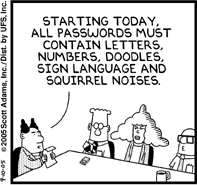 |
| [Source: wikimedia.org] |
It is highly likely that there is a scientific term for the approach and process that Scott has mastered over the years for distribution of his verbal as well as pictorial ideas. If you are an expert in linguistics, literature or forensics, feel free to comment. As a layman -a claim that an engineer may make only in exceptional circumstances- the whole product has an experience similar to having a butterscotch pastry. Let's examine how.
Humor is the cake which may sound the least important ingredient, but in fact it is the base of the structure of the pastry. The paragraphs that build the argument in cascading manner are like digging into layers of cream that confirms the flavor in a gradually increasingly reinforcing manner. Clever word play are those crunchy burned sugar nuggets confusingly called butterscotch in spite of them having no intoxicating properties. A sly spin of rejection of a popular belief is the icing and cherry on the top which is the lure for you to dig in. The overall simplicity of the package makes it suitable for many palates. And at the end of it all, depending on your own perception of your mental and physical health, if you end up having a feeling of guilt over a creamy rich diet, you can easily blame it onto being hypnotized to indulge in the first place.
If you are also a regular follower of Scott's journey over the past decade this narration may sound familiar in two ways. In terms of the message as well as the bottle. The later being the style in which the message is being delivered. Internet is silent on any attempts of writing about Scott the way Scott does it. If this blog entry appears to be doing so, it is purely an accident. My limited knowledge about hypnotism suggests that it is all about doing according to the mimes of the hypnotist.
Which now brings us to the main business today of the three best blog posts that Scott has published over the last month. Apparently, the list of all the great ideas that Scott has aired through the giggling belly of the cosmos over the years may become too large to be handled under a single spell on a lazy summer Sunday. Here are my picks:
- Mar 29 - Gerardo and the Mob: "The public fight starts when the word "responsible" enters the conversation. Responsibility isn't a natural element of the universe. It's a useful but artificial concept, like fairness, that society uses to control its members."
- Mar 19 - The War on Parents: "Sometimes it feels as if our school system is at war with parents, and winning. The kids are just the ammunition."
- Mar 9 - The Unaware: "Imagine you're a detective, and you have to solve the case of how incompetent you are. What evidence can you find to support the assumption you have about your own incompetence?"
Sunday, March 25, 2012
Kantian Ethics And Human Dignity
“Act only according to that maxim whereby you can, at the same time, will that it should become a universal law.” - Immanuel Kant (Categorical Imperative. try here)In this rather short video clipped from the BBC documentary - "Justice: A Citizen's Guide to the 21st Century", Prof. Michael Sandle picks up an ethical dilema from a real-life kidnapping case that took place in Germany in 2002, and bounces it off to a Kantian activist and journalist, and to Peter Singer, the utilitarian Bioethics professor at Princeton University.
A kidnapper of a eleven year old boy of a banker in Germany, after collecting the ransom, is caught by the authorities. When he refused to divulge the whereabouts of the boy, the police threatened him of extreme torture. The kidnapper gave into the threats and confessed to murdering the boy. The German authorities, after further investigation, sentenced the kidnapper with life sentence, while at the same time, the police chief was also prosecuted and sentenced for violating the human dignity of the convict. A judge from German constitutional court is heard defending the police chief's prosecution by saying, "There are certain inherent qualities in a person that the person cannot forfeit even by doing the worst of deeds possible."
Peter Singer, from his utilitarian position, dismisses the whole Kantian idea -as followed by the German court in this case- and defends the police chief's actions. The way the (editing of the) clip suggests, Singer's primary issue with the Kantian thoughts seem to be their approach of non-action, but his position seems to begin weakening when Sandel challenges him by supposing that "let's assume the perpetrator wouldn't talk even under extreme torture, but he would talk if you tortured his 14 year old daughter", would Singer allow that? When Sandle adds more "numbers" into the equation, the utilitarian squeeze becomes even more prominent.
Apparently, the answer isn't easy. Though, uneasily perhaps, it seems surprisingly easy to relate to the effects of using man as means rather than respecting his human dignity as ends, with the experience where man seems to witness the everyday world being used as a commodity, that includes himself.
Thursday, February 23, 2012
Humor: Sheldon's Prayer
Theoretical Physicist Dr. Sheldon Cooper Sc.D. has hardly anything to do with this post except for an optimistic allusion toward his positive delight at throwing a monologos tantrum such as this in any of The Big Bang Theory episodes preferably not named as the same suggested title.
 You see,
All metaphysics, of/for every
sectarian-/semi-/secular-/pseudo-/anti-religion's theory seems to thrive
on this evolutionary blindspot
in the cognitive process;
Hit by unreferenceable 'knowing';
And admixed with confused human imaginations.
Saturday, May 07, 2011
Cheers to Life!
7th May, 2011
David Hume’s Tercentenary had been in good attendance. New York Times writes:

Hume's philosophy has inspired a significant branch of cognitive and analytics philosophers and thinkers over the last three centuries. His theory of "Problem of Induction" has stirred many debates. Most recently, it has been assumed by Nassim Taleb as one of the core concepts of his "Randomness". Many credit Sir Karl Popper’s comprehensive response to "Problem of Induction" as the penultimate insight into reality of the modern society.
David Hume’s Tercentenary had been in good attendance. New York Times writes:
Saturday [May 7th] is the 300th birthday of David Hume, the most important philosopher ever to write in English according to the Stanford Encyclopedia of Philosophy.

Hume's philosophy has inspired a significant branch of cognitive and analytics philosophers and thinkers over the last three centuries. His theory of "Problem of Induction" has stirred many debates. Most recently, it has been assumed by Nassim Taleb as one of the core concepts of his "Randomness". Many credit Sir Karl Popper’s comprehensive response to "Problem of Induction" as the penultimate insight into reality of the modern society.
Friday, January 21, 2011
SKR, Education, Three videos, and "3 idiots"

EVERY ONCE IN A WHILE THERE COMES AN IDEA THAT has at least three beautiful things together: holistic relevance, sincerity towards applicability, and honest and bold presentation. Such ideas carry an element for illumination and invokes belief in the audience.
Let's listen to Sir Ken Robinson (SKR). The Professor of Education has thus far given two of the best and most popular TED talks (see below). His ideas on the challenges of modern Education systems across the world, and possible solutions through paradigm shift have been path-breaking (including, earning the professor his knighthood).
When the idea is larger than life, it is often easy to miss the whole picture while focusing on the point if delivery of the idea, beautiful that it mostly is. For this reason, RSA Animation has done a great job in the video below in creating a sort of "skeleton key" based on SKR's RSA speech - Changing Education Paradigm. Within a couple of minutes into the animation, it is most likely that one gets reminded of some of the ideas that got reflected in Raju Hirani's recent bollywood script "3 idiots", that made the film immensely popular.
- See also:
- Go here for the official website of Sir Ken Robinson, and here for his wikipedia entry.
- Three videos: 1) TEDtalk-Do schools kill creativity? (Feb 2006, Monterey CA, ~20:00m), 2) TEDtalk-Bring on the learning revolution! (Feb 2010, LA, ~20:00m), 3) RSA lecture-Changing Paradigms (~55:00m)
- Go here for various publications, and here for the list on Amazon.com
Sunday, December 26, 2010
HBR: Most Popular Articles of 2010
AN EXCITING YEAR IS DRAWING TO A CLOSE. Coming full circle of seasons it is winter again while the haven freezes over and a friend messaged from Leh in north-western Himalayas, "Its -15.4° C (4.2° F) here. Expect snow typing." I am almost sure it was meant to read "slow typing".

HBR on their part collectively published some 1000+ articles over the last 365 days. Recently, one of the editors listed the top 10 most popular articles among them (try here). Listed below are the five articles that I liked most.
1. Why I Returned My iPad by Peter Bregman
Peter Bregman stands in a two-hour queue-for-a-gadget for the first time to get his hands on iPad on its launch day. And within days, he is hooked. In this I-fear-I-might-loose-boredom post, Bregman talks about returning his iPad to Apple because it was "too good". He writes, "It's too easy. Too accessible. Both too fast and too long-lasting. For the most part, it does everything I could want. Which, as it turns out, is a problem." Because, he feared, he might loose his boredom, and hence, creativity. Go here to know why. [Tags: Managing yourself, Time management]
2. 12 Things Good Bosses Believe by Robert Sutton
Coming from Sutton’s popular book "Good Boss, Bad Boss", this short article is more of a link list where the items in the list go on to become articles in themselves. Some pretty common-sense stuff that sounds too apparently recognizable and one might just nod one’s head through it without the real attention or much effort in remembering it. That’s where the associated articles come in useful. Go here for the first branch of the tree. [Tags: Managing people, Leadership]
3. The Best Cover Letter I Ever Received by David Silverman
This remains one of the most popular articles of 2010 even though Silverman actually published it the year before. The answer to the question in the title is rather sarcastic. Silverman doesn't want people to waste time over writing cover letters, and explains the reasons in this post. Go here for this short and sweet post, and go here for his preceding and popular article - How to Write a Résumé That Doesn't Annoy People. [Tags: Career planning, Hiring, Business writing]
4. Define Your Personal Leadership Brand by Norm Smallwood
Smallwood published his book around personal branding about three years ago. This article provides a decent synopsis of his overall ideas. Targeted at leaders in general and consultants in particular, this five-step approach is a good lead to put the basics in place, and to build upwards from there. How different this is from developing and grooming a leadership personality? Well, I suppose a "personal leadership brand" is short-lived in comparison, and like most products, it carries a shelf-life and an expiry date. Go here for your own branding tips. [Tags: Personal effectiveness, Leadership development]
5. Six Social Media Trends for 2011 by David Armano
Published earlier this month, this forecasting post talks about the six likely trends that we could encounter in '11: Social media integration in corporate policies, Cheaper devices and faster connectivity, Facebook reigning over Foursquare for more business-friendly services, Social media schizophrenia and Identity crisis, Google to "strike back", and finally, Integration of brands in Social media e.g. Apple + Twitter = Ping. Go here for Armano's blog post. [Tags: Social media]

HBR on their part collectively published some 1000+ articles over the last 365 days. Recently, one of the editors listed the top 10 most popular articles among them (try here). Listed below are the five articles that I liked most.
1. Why I Returned My iPad by Peter Bregman
Peter Bregman stands in a two-hour queue-for-a-gadget for the first time to get his hands on iPad on its launch day. And within days, he is hooked. In this I-fear-I-might-loose-boredom post, Bregman talks about returning his iPad to Apple because it was "too good". He writes, "It's too easy. Too accessible. Both too fast and too long-lasting. For the most part, it does everything I could want. Which, as it turns out, is a problem." Because, he feared, he might loose his boredom, and hence, creativity. Go here to know why. [Tags: Managing yourself, Time management]
2. 12 Things Good Bosses Believe by Robert Sutton
Coming from Sutton’s popular book "Good Boss, Bad Boss", this short article is more of a link list where the items in the list go on to become articles in themselves. Some pretty common-sense stuff that sounds too apparently recognizable and one might just nod one’s head through it without the real attention or much effort in remembering it. That’s where the associated articles come in useful. Go here for the first branch of the tree. [Tags: Managing people, Leadership]
3. The Best Cover Letter I Ever Received by David Silverman
This remains one of the most popular articles of 2010 even though Silverman actually published it the year before. The answer to the question in the title is rather sarcastic. Silverman doesn't want people to waste time over writing cover letters, and explains the reasons in this post. Go here for this short and sweet post, and go here for his preceding and popular article - How to Write a Résumé That Doesn't Annoy People. [Tags: Career planning, Hiring, Business writing]
4. Define Your Personal Leadership Brand by Norm Smallwood
Smallwood published his book around personal branding about three years ago. This article provides a decent synopsis of his overall ideas. Targeted at leaders in general and consultants in particular, this five-step approach is a good lead to put the basics in place, and to build upwards from there. How different this is from developing and grooming a leadership personality? Well, I suppose a "personal leadership brand" is short-lived in comparison, and like most products, it carries a shelf-life and an expiry date. Go here for your own branding tips. [Tags: Personal effectiveness, Leadership development]
5. Six Social Media Trends for 2011 by David Armano
Published earlier this month, this forecasting post talks about the six likely trends that we could encounter in '11: Social media integration in corporate policies, Cheaper devices and faster connectivity, Facebook reigning over Foursquare for more business-friendly services, Social media schizophrenia and Identity crisis, Google to "strike back", and finally, Integration of brands in Social media e.g. Apple + Twitter = Ping. Go here for Armano's blog post. [Tags: Social media]
Friday, December 24, 2010
Book: "Inside Steve's [Jobs] Brain"
WHILE READING "Inside Steve’s Brain" (sic) by Leander Kahney I got reminded of the following anecdote:
Apple Inc. (NASDAQ: AAPL, the world's largest IT company by market cap) fan following has attained a sort of a cult status for some time. And perhaps a similar experience could be derived by a business oriented mindset trying to approach "Inside Steve's Brain". It is a book that tells the story of an individual’s work-life, sketchily and at time contradictorily, and irrespective of what the text claims on the cover the book makes it rather difficult to draw business lessons out of it – unless one counts ‘gospels’ among them, akin to God’s word that cannot be challenged. The writer hardly makes any attempts in drawing his own conclusions or opining about certain event, or the controversies, or the specific products, or even the fallouts. Whatever is being said, is said by somebody else, and there are references quoted about them, which seem to come straight out of Google search results.
One can’t afford be judgmental about this being either a work of fiction or a factual biography; for anyone hardly knows, let alone understands, “The Holy Ghost” Steve Jobs (cf. pp112). The book takes off fairly well, and evidently Kahney has worked on “Forward” and the first chapters. But the landing is rough – from an iPod design studio to directly into acknowledgements is rather abrupt and bumpy. The writer should have cared to close the loop - summery pages would be an asset here. Towards the last 10% the reader gets a bit tired; suggesting that the writer was tired by the last couple of chapters.

But one must consider reading this book. At least for its entertainment value. It should also make a good companion for Pirates of Silicon Valley (try here ). And most apparently, should sugarcoat the bitterness of the aftertaste of other fictions like iCon (try here
 ). Initially, the title suggested that the book is a collection of leadership lessons, if not psychological analysis, about this enigmatic personality at the helm of Apple Inc. It turned out to be a gross error of judgment: First, there cannot be leadership lessons here, for Steve is not a leader in the classical sense of modern leadership. (In the contemporary sense of classical leadership? A "Great intimidator"? Perhaps yes, like many Generals in the army with their typical command-and-control leadership). And secondly, it is most likely that any attempt of psychoanalysis would end up in a lawsuit.
Apple products speak for themselves. Almost anyone who likes to love, hold and showoff a piece of electronics knows that a visit to the nearby Apple Imagine store does the trick. This book might just make that experience more enjoyable. On the other hand, if you are tech novice, looking for a practical yet well-built device and haven’t been to any Apple experience, the book might help you take the plunge and contribute toward your loss of innocence. And one would actually love Steve here before it start getting a little irritating, and then one is left to looking for his or her own reasoning to continue loving. Mostly, one finds one.
For that, Kahney deserves credit and appreciation for sure. And then, also for sticking his neck out and going all out in praising the man he adores.
Go here to check out the book at Amazon.
This diplomat from the East was deputed to their embassy in Washington DC, in the United States. Having come to live in a Western country for the first time, the little man decided to pick up the holy book and began studying it in hopes of getting acquainted to the new culture more thoroughly. After a while when he met with a professor of religious studies at one of the colleges in New York, the humble man pronounced his predicament that after reading through the book almost three times over, he couldn’t figure out any religion in it.Nothing could be more illuminating in terms of human mindsets. For example, to an Eastern mindset that is used to live a life with abstractions and of elemental powers, such as the dance of the Shinto priests who proudly claim to have no theology; or with millennia old traditions of having religion a part of the daily routine as naturally as sun-drying the woodblocks with Indian sandalwood to gain aroma out of stove; understandably it could be a difficult comprehension in considering a given narration about a certain ruling family of a given tribe of Levantian peoples as a dictum of mainstream and organized religious practice, with due respects that it being the most successful, loved and practiced one in our contemporary world.
Apple Inc. (NASDAQ: AAPL, the world's largest IT company by market cap) fan following has attained a sort of a cult status for some time. And perhaps a similar experience could be derived by a business oriented mindset trying to approach "Inside Steve's Brain". It is a book that tells the story of an individual’s work-life, sketchily and at time contradictorily, and irrespective of what the text claims on the cover the book makes it rather difficult to draw business lessons out of it – unless one counts ‘gospels’ among them, akin to God’s word that cannot be challenged. The writer hardly makes any attempts in drawing his own conclusions or opining about certain event, or the controversies, or the specific products, or even the fallouts. Whatever is being said, is said by somebody else, and there are references quoted about them, which seem to come straight out of Google search results.
One can’t afford be judgmental about this being either a work of fiction or a factual biography; for anyone hardly knows, let alone understands, “The Holy Ghost” Steve Jobs (cf. pp112). The book takes off fairly well, and evidently Kahney has worked on “Forward” and the first chapters. But the landing is rough – from an iPod design studio to directly into acknowledgements is rather abrupt and bumpy. The writer should have cared to close the loop - summery pages would be an asset here. Towards the last 10% the reader gets a bit tired; suggesting that the writer was tired by the last couple of chapters.

But one must consider reading this book. At least for its entertainment value. It should also make a good companion for Pirates of Silicon Valley (try here
). And most apparently, should sugarcoat the bitterness of the aftertaste of other fictions like iCon (try here). Initially, the title suggested that the book is a collection of leadership lessons, if not psychological analysis, about this enigmatic personality at the helm of Apple Inc. It turned out to be a gross error of judgment: First, there cannot be leadership lessons here, for Steve is not a leader in the classical sense of modern leadership. (In the contemporary sense of classical leadership? A "Great intimidator"? Perhaps yes, like many Generals in the army with their typical command-and-control leadership). And secondly, it is most likely that any attempt of psychoanalysis would end up in a lawsuit.Apple products speak for themselves. Almost anyone who likes to love, hold and showoff a piece of electronics knows that a visit to the nearby Apple Imagine store does the trick. This book might just make that experience more enjoyable. On the other hand, if you are tech novice, looking for a practical yet well-built device and haven’t been to any Apple experience, the book might help you take the plunge and contribute toward your loss of innocence. And one would actually love Steve here before it start getting a little irritating, and then one is left to looking for his or her own reasoning to continue loving. Mostly, one finds one.
For that, Kahney deserves credit and appreciation for sure. And then, also for sticking his neck out and going all out in praising the man he adores.
Go here
to check out the book at Amazon.Sunday, November 07, 2010
TED 2011 Prize Goes to "Anonymous" J R
TED PRIZE IS AN ANNUAL AWARD INVOLVING USD 100,000 AND SUPPORT TO AN IDEA TO CHANGE THE WORLD. The 2011 prize has been awarded to someone only known as JR. It is believed to be a French photographer and artist, who anonymously painted and created installations on the walls of the world – mainly the urban slums. Known as "pervasive art", JR took help from urban volunteers to create black & white paintings on large urban walls and highlights the burning issues of the city and the region.
Writings on the wall, literally.
While the Guardian featured him as "the hippiest street artist" earlier this year, the 27 years old prefers the term "photograffeur", adding that, "If there is one thing I've always taken care of with my work, it's that it's never an advertisement for anything other than the work itself and for the people it's about — no 'Coca-Cola presents'". Fiercely protective of his anonymity, he actually appeared with sunglasses and a hat when the TED organizers first got in touch with him on Skype after the prize announcement. The anonymity is crucial for his work. It allows his to travel freely and take on large projects, and it also helps avoiding the distraction away from his actual work and the main message. Representing people living on the margins, JR's anonymity goes with his philosophy of representing the nameless.

In his late teen years, JR found a camera dropped by someone in the Paris metro and took on photography from there. He sampled various graffiti artists across Europe for a couple of years, and in 2002 started work on his first major project. In 2003, two major photographs were discovered on the walls of Paris and Rome each. "Portrait of Generation" came after three years when the slums of Paris witnessed huge portraits highlighting the marginal population. In 2007, eight cities on either sides of Israel-Palestine border found installations by JR involving photographs of a rabbi, imam and priest. This was the largest illegal exhibition of its kind in Europe. The following years found him in different countries of Africa, South America and Asia (see the trailer for "Women Are Heroes" below).
The coveted TED prize money may not seem as high as other contemporary awards, but the real deal is with the one idea that JR can put forward to the TED community at large towards implementation. TED can mobilize its global reach of motivated individuals, garner large corporate donations through its affiliates, and provide platform for debates, discussions and diffusion of the ideas. JR has been surviving on money generated through various auctions of his art, which goes towards expenses of prints and materials of his various larger-than-life campaigns. The financial aid shall help keep JR independent as he is, and the limelight through TED could inspire similar artists to take up social causes of similar nature. The British celebrity chef Jeremy Oliver was the winner of the prize last year, and his TED 'wish' has been a war against obesity. The year before, former American president Bill Clinton was the winner, and he channelized resources towards rebuilding the health-care system in Rwanda.
When the Ted team reached out to him, JR was in Shanghai campaigning against the destruction of older buildings and habitats of the elderly and the poor. He said that he had learnt of the award only recently and hadn't thought about the 'wish' yet, though it was to be on the same line as his campaigns in the slumps of Brazil, Cambodia, and Kenya. Further, the apparently bigger challenge than deciding his wish would be the impact that such limelight might bring to his anonymity and freedom to operate.
Following are some of JR's "ideas worth spreading":
"Women Are Heroes" - part of the campaign that took place in Kenya: (at YouTube)
Writings on the wall, literally.
While the Guardian featured him as "the hippiest street artist" earlier this year, the 27 years old prefers the term "photograffeur", adding that, "If there is one thing I've always taken care of with my work, it's that it's never an advertisement for anything other than the work itself and for the people it's about — no 'Coca-Cola presents'". Fiercely protective of his anonymity, he actually appeared with sunglasses and a hat when the TED organizers first got in touch with him on Skype after the prize announcement. The anonymity is crucial for his work. It allows his to travel freely and take on large projects, and it also helps avoiding the distraction away from his actual work and the main message. Representing people living on the margins, JR's anonymity goes with his philosophy of representing the nameless.

[Above: "Giving Slums a Human Face". Source: J R/Agence UV]
In his late teen years, JR found a camera dropped by someone in the Paris metro and took on photography from there. He sampled various graffiti artists across Europe for a couple of years, and in 2002 started work on his first major project. In 2003, two major photographs were discovered on the walls of Paris and Rome each. "Portrait of Generation" came after three years when the slums of Paris witnessed huge portraits highlighting the marginal population. In 2007, eight cities on either sides of Israel-Palestine border found installations by JR involving photographs of a rabbi, imam and priest. This was the largest illegal exhibition of its kind in Europe. The following years found him in different countries of Africa, South America and Asia (see the trailer for "Women Are Heroes" below).
The coveted TED prize money may not seem as high as other contemporary awards, but the real deal is with the one idea that JR can put forward to the TED community at large towards implementation. TED can mobilize its global reach of motivated individuals, garner large corporate donations through its affiliates, and provide platform for debates, discussions and diffusion of the ideas. JR has been surviving on money generated through various auctions of his art, which goes towards expenses of prints and materials of his various larger-than-life campaigns. The financial aid shall help keep JR independent as he is, and the limelight through TED could inspire similar artists to take up social causes of similar nature. The British celebrity chef Jeremy Oliver was the winner of the prize last year, and his TED 'wish' has been a war against obesity. The year before, former American president Bill Clinton was the winner, and he channelized resources towards rebuilding the health-care system in Rwanda.
When the Ted team reached out to him, JR was in Shanghai campaigning against the destruction of older buildings and habitats of the elderly and the poor. He said that he had learnt of the award only recently and hadn't thought about the 'wish' yet, though it was to be on the same line as his campaigns in the slumps of Brazil, Cambodia, and Kenya. Further, the apparently bigger challenge than deciding his wish would be the impact that such limelight might bring to his anonymity and freedom to operate.
Following are some of JR's "ideas worth spreading":
"Women Are Heroes" - part of the campaign that took place in Kenya: (at YouTube)
Friday, October 15, 2010
HBR: What Is The Work Of The CEO?
"The CEO is the link between the Inside that is 'the organization,' and the Outside of society, economy, technology, markets, and customers. Inside there are only costs. Results are only on the outside."Alan ("A.G.") Lafley TOOK OVER AS CEO of Procter & Gamble in June 2000 when the FMCG behemoth was battling turbulent times. At 6pm on his first day at the office as the new (and first time) CEO he was facing a hostile press conference live on national television – like a "deer in the headlights" as he recalls. P&G stock price that had crashed from $86 to $60 in one day tanking Dow index by 374 points, went further down by 11% at the news of Lafely's appointment as the new chief. The headlines went from "P&G Investor Confidence Shot" to "We love their products, But we hate their stocks." to "Does P&G Still Matter?"
-- Peter Drucker, "The American CEO"

Four years into working hard at trying to turn the tide and leading P&G as the chief executive, one day out of the blue, A.G. decided to give a call to Peter Drucker at his residence. Drucker, 83 at that time, answered the calls himself, and apparently invited A.G. to come over for a chat.
In October 2004, A.G. and a groups of executives spent quality hours discussing the leadership challenge with Peter Drucker at his residence. Drucker made numerous side notes during the meetings, and others made notes of Drucker's advisory quotes and observations. In 2009, before retiring after 10 years as the CEO of P&G, A.G. compiled an HBR article and published a very interesting case study on how he turned around P&G's fortunes to make it one of world's largest consumer goods manufacturer. On the larger part, A.G. credits Drucker for his strategy and success.
In a nutshell, A.G. Lafley notes the following four fundamental tasks of the CEO as per Drucker’s simple and clear observations, with Drucker's comments as quotes:
1. DEFINE The Meaningful Outside –
Determine which external constituency matters most. Your company has many stakeholders, each with important demands. Once you’ve defined your most important external constituency, ensure that everyone acts on that understanding.
2. DECIDE What Business You Are In –
"Equally important—and also a task only the CEO can fulfill—is to decide, What is our business? What should it be? What is not our business? And what should it not be?"For example, what are your core businesses, and which of them will you grow? Analyze the attractiveness of the businesses you’re already in, your company’s position in existing industries relative to competitors’, and industries’ strategic fit with your core competencies.
3. BALANCE The Present And The Future –
"The CEO decides on the balance between yield from the present activities, and investment in an unknown, unknowable and highly uncertain future... it is a judgment rather than [a decision] based on 'facts.'" Adding that, "Effective CEOs make sure that the performing people are allocated to opportunities rather than only to 'problems.' And they make sure that people are placed where their strengths can become effective."Ensure that stakeholders’ near-term interests don’t overshadow your company’s long-term future. Balance short-term investments with investments in resources needed for your company’s longer-term future.
4. SHAPE Values and Standards –
"CEOs set the values, the standards, the ethics of an organization. They either lead or they mislead."Define your company’s values (its identity) and standards (expectations) in ways that encourage the right behaviors.
- See also:
- Related article: HBR: Managing Oneself - by Peter Drucker
- Related article: "What would Peter do?" – A Tribute at Drucker Century
- Go here for A.G. Lafley's HRB article: "What Only the CEO Can Do"
- Go here for more on A.G. Lafley at "Leading Authorities" website
Saturday, October 09, 2010
Sachin Tendulkar’s Stock Market Run

AUSTRALIA, THE DOMINANT SPORTING powerhouse among the 71 the Commonwealth countries, have invested into researching India’s cricket performance and how it relates to equity trading at Bombay Stock Exchange and National Stock Exchange of Dalal Street in Mumbai, India. The market cap of BSE stands close to USD 1.4 trillion, and NSE, with market cap of nearly USD 1.5 trillion, is the third largest Stock Exchange in the world in terms of the number of trades in equities.
Australia were dethroned by India from #1 spot for ICC test cricket ranking earlier this year, and are being challenged for their spot for the ODI ranking as the contest is on. And their desperation is evident on the field while the Test Series between the two national sides is currently under way.
As Sachin Tendulkar, the cricketing legend goes on to slam his sixth double century for India, his second against Australia, (and the only International player to ever score a double hundred in the ODI format of the game), the report by the economists goes on to suggest that when Sachin is playing in good form and ends up on the losing side, the stock-market takes an additional 20% hit on the negative side.
Russell Smyth, Head of Economics department at Monash University of Australia and economist Vinod Mishra have the following to say:
"While a win by the Indian cricket team has no statistically significant upward impact on stock market returns, a loss generates a significant downward movement in the stock market.Edit: included score details from the 2nd Test match between Australia and India.
India's main index, the CNX Nifty, shows that the Nifty index was generally flat the day after a win, but the day following a loss, the index dropped by an average of 0.231 per cent. The drop following a loss was more than seven times greater than the movement following a win.
In the 100 matches in which Tendulkar played and India lost, the average return the day after the match was 0.328 per cent, an 18 per cent higher drop compared to the average drop after losing a match (which Tendulkar did not play).
A feeling of sadness might make investors withdraw from the world and the stock market, thus resulting in reduced trading for a while, whereas anger might make them behave in an impulsive manner, which might involve selling of a lot of the stocks."
- See also:
- Related post: Sach Is Life
- Go here for Financial Times coverage on the Smyth & Mishra report, here for Indian Express coverage and here for Deccan Herald take on the topic
- Go here for report on Tendulkar, 37, and after 21 years on the international pitch, clinching yet another ICC Player of the Year
- Go here for a similar report at cxoadvisory.com linking American NFL Super Bowl with Stock market
Saturday, October 02, 2010
Oct 2 - Mahatama Gandhi at 141

[Photo courtesy: Amitabh Bachchan]
"If blood to be shed, let it be our own.
Let us cultivate the calm courage to die without killing."
~ Mahatma Gandhi (2 October 1869 – 30 January 1948)
[Above] A video clipping of Gandhi's speech challenging Jan Smuts' racist law of segregation. From Attenborough's epic - Gandhi: The World Event.
Richard Attenborough writes in his compilation book:
"[Gandhi's] words struck me so forcibly that there and then I committed myself to attempt to make a film about Mahatma Gandhi - a commitment that changed the subsequent twenty years of my life."
- See also:
- Try http://youtu.be/e3tjIiWIkAQ for the clip on YouTube.
- Go here for Richard Attenborough's compilation book The Words of Gandhi.
Saturday, September 04, 2010
A Thousand-days Challenge
"It is not the mountains we conquer but ourselves."HOW WOULD IT FEEL to be up close and personal with Mt. Everest?
~ Sir Edmund Hillary
Or to humbly come to face with the Chomolangma ("Saint Mother") as they say in Tibet?
Well, we shall find out in next thousand days or less. Because that's the pledge: To camp underneath the summit of Mt. Everest within next 30 odd months or so.
A thousand days may seem rather stretched, but for a goal such as this, it may all get tight pretty quickly. And needless to say that a much more detailed planning and preparations are required - a whole mountain to surmount in itself before the actual one - mainly towards the physical fitness and mental toughness - as well as evaluating other professional, social and economical commitments and feasibilities. Over the past week or so while the decision over the destination for the challenge has been under debate, some of these aspects have been taken into due consideration. And, that helps.

A couple of pointers and a bit of background: While Mt. Everest has always been at the top of the list of dearness, Lewis Pugh's recent TED talk gave the final push. And though Mt. Everest is a more complicated and rather tougher ballgame all together, it was nice to read the encouraging post by Matt Cutts of Google from Kilimanjaro. Also, Chris Guillebeau had an interesting post a couple of years ago at his unconventional strategies blog asking to name one definitive place that one would want to visit in the lifetime (thanks Amelia for the link).
Subscribe to:
Posts (Atom)